
- Home
- ACADEMIC
- Religious Studies
- Religion, Nature and the Environment
- Climate Anxiety and Spiritual Resilience
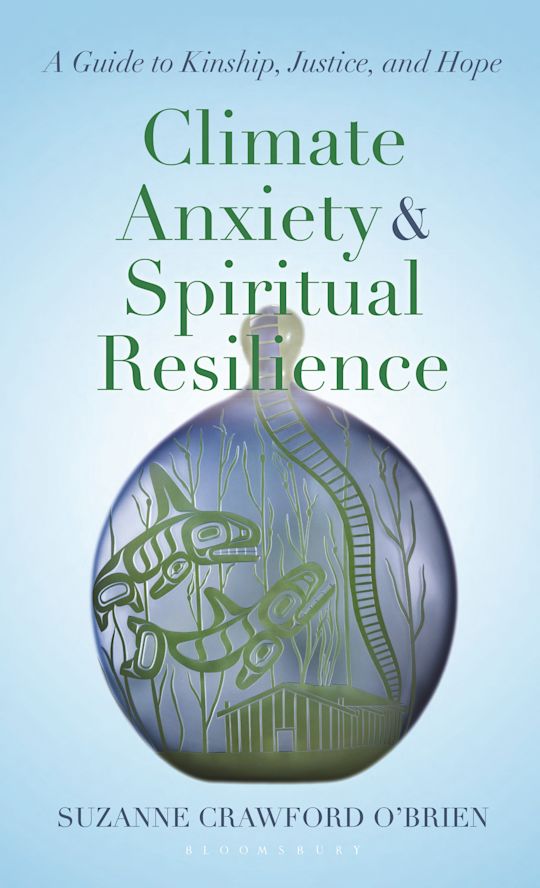
Climate Anxiety and Spiritual Resilience
A Guide to Kinship, Justice, and Hope
Buying pre-order items
Ebooks and Audiobook
You will receive an email with a download link for the ebook or audiobook on the publication date.
Payment
You will not be charged for pre-ordered books until they are available to be shipped. Pre-ordered ebooks will not be charged for until they are available for download.
Amending or cancelling your order
For orders that have not been shipped you can usually make changes to pre-orders up to 72 hours before the publishing date.
Payment for this pre-order will be taken when the item becomes available
You must sign in to add this item to your wishlist. Please sign in or create an account
Description
Religious and Indigenous practices that counter despair, cultivate courage, and sustain moral action in the fight for environmental justice. Climate change is an ecological and political crisis, but it is also a spiritual one. Fractured relationships with the natural systems that sustain us and frustration with leaders' seeming inability to respond, has led many to grief, despair, burnout, and moral exhaustion. Indeed, current research on eco-anxiety and climate grief show that emotional overwhelm undermines collective action, even when solutions are known and available.
But there is a path forward, one found within religious and Indigenous traditions that have long cultivated practices for living with loss, sustaining hope, and acting ethically within fragile ecosystems. By bringing the psychology of climate grief into conversation with Indigenous and religious traditions, this book offers a framework for moving beyond paralysis toward resilient, justice-centered engagement. Each chapter draws on case studies from diverse Indigenous and religious traditions. challenging extractive worldviews, emphasizing relationality and interdependence, and grounding justice in care for land, community, and future generations. Together, they explore what it means to engage in inner activism: the work of moral courage, clarity, and presence that makes sustained ecological action possible. Practices of mindfulness, ritual, lament, storytelling, and community accountability are presented not as private coping strategies but as sources of collective resilience and ethical commitment. Emphasizing hope without denial and action without burnout, this book offers spiritual resources for transforming grief into courage, solidarity, and sustained engagement for ecological justice.
Table of Contents
Acknowledgments
1. Climate resilience is spiritual resilience
2. Retrain your brain: Lessons from climate psychology
3. Lament can change the world
4. Feeding resilience
5. Sleep is sacred
6. Mindful movement
7. Climate contemplation
8. Climate kinship
9. Decolonizing climate work
10. Learn to listen
11. Climate calling
12. Hope is a ceremony
Notes
Index
Product details

| Published | 06 Aug 2026 |
|---|---|
| Format | Ebook (PDF) |
| Edition | 1st |
| Pages | 280 |
| ISBN | 9798216278818 |
| Imprint | Bloomsbury Academic |
| Illustrations | 1 b&w photo |
| Publisher | Bloomsbury Publishing |
About the contributors
Reviews
-
I talk a lot about the need for a spiritual revolution in response to the crises of our time. Suzanne Crawford O'Brien takes us to one of the clearest places that revolution is needed: our relationship with the Earth. Climate Anxiety and Spiritual Resilience reminds us that healing the planet will require not only science and policy-but a transformation of the human spirit.
Rainn Wilson, actor, podcaster, producer, director, and author of Soul Boom: Why We Need a Spiritual Revolution
-
This is a generous and open-hearted book, and it will be a great resource for people trying to figure out how we make our collective way through an overheated century.
Bill McKibben, author of Here Comes the Sun
-
Climate Anxiety and Spiritual Resilience is a wise, grounded companion for anyone feeling the emotional weight of a warming world. Suzanne Crawford O'Brien weaves together spirituality, justice, and kinship with deep compassion. The book steadies the heart while inviting us into right relationship with one another and the living Earth.
Leslie Davenport, author of Transforming Climate Anxiety: A Workbook for Courage, Clarity, and Collective Action.
-
When conversations in the classroom or with friends turn to climate change or the broken political systems wreaking havoc on the Earth's ecosystems, it is easy to devolve toward despair. In Climate Anxiety and Spiritual Resilience, Crawford-O'Brien provides a thoughtful reframing of climate change as a spiritual problem, and furnishes readers with a rich array of ideas and practices that can help them respond with meaning and moral resolve. Drawing on a wide range of scholarly voices, religious traditions, and indigenous spiritualities, her honest, heartfelt prose guides readers toward an affirmative power to make the futures they want for themselves.
Evan Berry, Senior Global Futures Scholar and Professor of Environmental Humanities, Arizona State University, USA
-
This book brings soul and ceremony to the heart of climate distress. O'Brien offers a rare weaving of the sacred and the practical and reminds us that spiritual resilience is not a retreat from the world's suffering, but a profound act of re-engagement with life, justice, and community.
Steffi Bednarek, Founder and Director of the Centre for Climate Psychology and Editor of Climate, Psychology and Change, UK
-
This book has so much to teach and to remind us all. The introduction tells us it is “a trail guide for those of us who know that restoring the world is sacred work.” If you don't know that yet, please read the book and be convinced. Then join me in gratitude for the wisdom Suzanne Crawford O'Brien has gathered in these pages. She presents a wealth of spiritual resources to expand our understanding of climate action. She encourages us to be our full selves, including facing our grief, anxiety, and other challenging feelings about the state of the world. She introduces us to dozens of ancestors and scholars who have found ways to turn such feelings into positive change. She offers hope that we can keep moving toward a better life in and with this earth. The trail ahead is not easy, but it will be easier, more joyful, and more inspiring with this book as a guide.
Kevin J. O'Brien, Professor of Religion, Pacific Lutheran University, USA