
Payment for this pre-order will be taken when the item becomes available
Description
'Life does not live.'
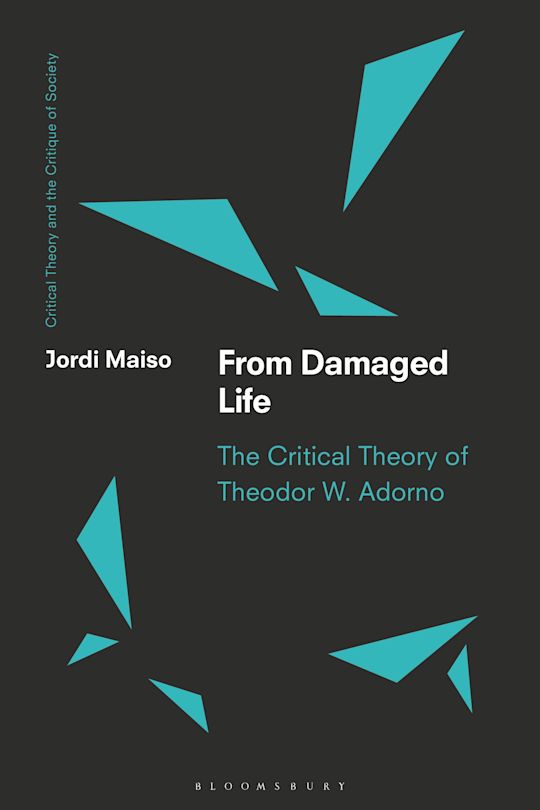
This certainty – that the conditions governing existence in contemporary societies generate irretrievably damaged lives – lies at the heart of Theodor W. Adorno's critical theory. Emerging from the historical experience of fascism, Auschwitz, and the consolidation of advanced capitalism, Adorno's thought articulates critique from within a damaged reality.
Under the coercion of overwhelming social powers, individual character is constituted as a “system of scars”. This notion of “damaged life” stands at the center of this book, which frames critique as emerging from a reality scarred by systemic coercion. It reconstructs Adorno's critical theory as an analysis of the new state of unfreedom linked to total socialization, the anthropological reshaping of subjectivity under advanced capitalism, and the very possibility of critique.
Jordi Maiso's analysis spans key themes: the constellation of fascism and advanced capitalism, the culture industry's role in shaping consciousness, and the persistence of authoritarian potential in everyday life. Revisiting Adorno's conception of critique as a “science of mourning” and his insistence on determinate negation, the book shows how critical thought confronts a historical moment in which emancipatory horizons appear blocked yet remain necessary.
Both historical and urgent, From Damaged Life: The Critical Theory of Theodor W. Adorno interrogates the persistence of fear, heteronomy, and avoidable suffering. It asks whether, under conditions marked by authoritarian regression and damaged subjectivity, critical theory can still resist resignation and keep the possibility of transformation alive.
Table of Contents
Part One: The Core of Experience and the Coordinates of Critique
Critical Theory as a “Science of Mourning”
I. RESIGNATION? HISTORY, EMANCIPATION AND BARBARISM
“After Auschwitz”
“Where is the proletariat?”
“From the standpoint of redemption”
II. DOES IT NOT HURT TO BE DEVOURED? THE POSITION OF THE CRITICAL INTELLECTUAL
The fragile nonconformity of the spirit
Art as a battlefield
Critical theory and praxis
III. A FAREWELL TO MARX? UNRAVELING CONTEMPORARY PREHISTORY
The “unity of an epoch”: Capitalism and fascism
Protohistory of contemporary prehistory
Absolutized self-preservation
Part Two: ADORNO AND THE CRITICAL THEORY OF CAPITALISM
In the Labyrinth of the Social Constitution
IV. A NEW STATE OF UNFREEDOM: THE LOGIC OF CAPITALIST SOCIALIZATION
Capitalist society as a “system”: a twist on totality
Capitalism as “natural history”
A social whole with no outside: “Total socialization”
V. CULTURE INDUSTRY: INTEGRATION AS MASS DECEPTION
The social location of culture
The culture industry as an instance of socialization
The “deception” of the culture industry and its limits
VI. TOWARDS A NEW TYPE OF HUMAN BEING: ANTHROPOLOGICAL TRANSFORMATION OF ADVANCED CAPITALISM
The historical decline of the individual and the sacrifice of the living
Traits of the “new type of human being”
Contradiction in the subject and the role of psychoanalysis
VII. STATES OF CONSCIOUSNESS AND UNCONSCIOUSNESS: THE NEW FIGURE OF IDEOLOGY
Sociality and appearance: The transformation of ideology
Critique of ideology and analysis of the self
“Normal monsters”: The persistent potential of authoritarianism
Coda: “THE LIMIT OF REIFICATION”: ADORNO AND LATE CAPITALISM TODAY
Product details

| Published | 20 Aug 2026 |
|---|---|
| Format | Ebook (PDF) |
| Edition | 1st |
| Pages | 352 |
| ISBN | 9781350562790 |
| Imprint | Bloomsbury Academic |
| Series | Critical Theory and the Critique of Society |
| Publisher | Bloomsbury Publishing |
Reviews
Related Titles