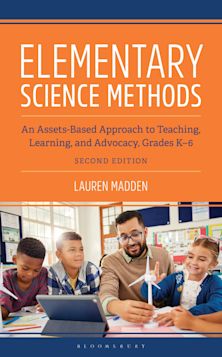
Elementary Science Methods
An Assets-Based Approach to Teaching, Learning, and Advocacy, Grades K–6
- Textbook
- Delivery and returns info
-
Free CA delivery on orders $40 or over
You must sign in to add this item to your wishlist. Please sign in or create an account
Description
The second edition of this textbook offers an up-to-date and practical guide to support excellent science teaching with even more ideas and tools to bring real-life, authentic science into elementary classrooms. This text meets the immediate, contextual needs of future and current elementary teachers by using an assets-based approach to science teaching, showing how to create inquiry-based lessons, differentiate instruction and lesson design based on children's developmental ages and needs, and providing easy-to-use tools to advocate for scientific teaching and learning guided by the Next Generation Science Standards. Updates in this book include strategies for addressing complex and sometimes controversial scientific issues such as vaccine hesitancy and climate change to ensure teachers are well prepared to support a scientifically literate populace.
Table of Contents
Acknowledgments
1 An Introduction to Assets-Based Elementary Science Teaching
2 A Developmental Perspective on Science Teaching and Learning
3 Inquiry-Based Teaching: Connecting Theory to Strategy
4 What Is (and Isn't) Science Anyway?
5 The Next Generation Science Standards: An Introduction
6 Asking Good Questions and Developing Lessons
7 Connecting Science to Language Arts and Mathematics
8 STEM and STEAM: Creativity and ProblemSolving in Elementary Science
9 Beginning to Use Science to Advocate
10 Equity, Diversity, and Inclusion in Science Teaching
11 How Do We Know What We Know in Science?
12 Science Outside of School
13 Advocating for Science
Glossary
References
Index
About the Author
Product details
| Published | Jan 17 2022 |
|---|---|
| Format | Paperback |
| Edition | 1st |
| Pages | 216 |
| ISBN | 9781538127124 |
| Imprint | Rowman & Littlefield |
| Illustrations | 12 b/w illustrations; 41 b/w photos; 13 tables; 8 textboxes |
| Dimensions | 230 x 154 mm |
| Publisher | Bloomsbury Publishing |
About the contributors
Reviews
-
To face some of the world’s greatest challenges, the importance of science and science education cannot be overstated. Lauren Madden embraces this perspective by cooking up truly inventive ways for teachers to weave scientific inquiry into day-to-day activities so that students easily move beyond meeting state standards to digesting and applying material. Equally important is her commitment to equity–offering up practical suggestions for ensuring that everyone gains equal access to the spaces opened through science. For science educators eager to forge the hearts and minds our world so desperately needs, this book will show you the way.
Randa Elbih, Assistant Professor, Department of Education/Special Education, University of St. Joseph
-
In this text, Madden presents a current and comprehensive portrayal of science education in the elementary setting in a smooth, engaging narrative. She anchors the work in an NGSS world impacted by climate change and a global pandemic. She promotes the critical importance of knowing your students and integrating their experiences as central assets to learning in classrooms embracing equity, diversity, and inclusion.
Bill Lindquist, professor emeritus, Hamline University
-
I was greatly impressed by the thoughtfulness that went into the design of Lauren Madden’s Elementary Science Methods: An Assess-Based Approach to Teaching, Learning and Advocacy, Grades K-6. This textbook embraces some of the most essential concepts in education today, such as multidisciplinary connections and equity, diversity, and inclusion. Lauren Madden realizes the elements that current, practicing teachers need to effectively engage students in science and ensure they are masters of the content area and prepared for the competitive global economy of the future.
Jessica Bogunovich, Assistant Professor of Education, UMass Global
-
Elementary Science Methods: An Assets-Based Approach to Teaching, Learning and Advocacy, Grades K-6 is an excellent resource for science teachers and educators to use to enable their students to construct their knowledge and understanding of science concepts. Lauren Madden not only applies the Next Generation Science Standards (NGSS) using the 3-D approach of “Disciplinary Core Ideas: Science Content, Science and Engineering Practices, and Crosscutting Concepts”, she also provides straightforward explanations with logical strategies for creating meaningful learning experiences. In addition, she provides challenging opportunities for teachers to think critically about their teaching and its effectiveness. I highly recommend this textbook for science teachers and science teacher educators, alike.
Marianne C. Phillips, Texas A and M University