The EU Artificial Intelligence Act
A Thematic Commentary


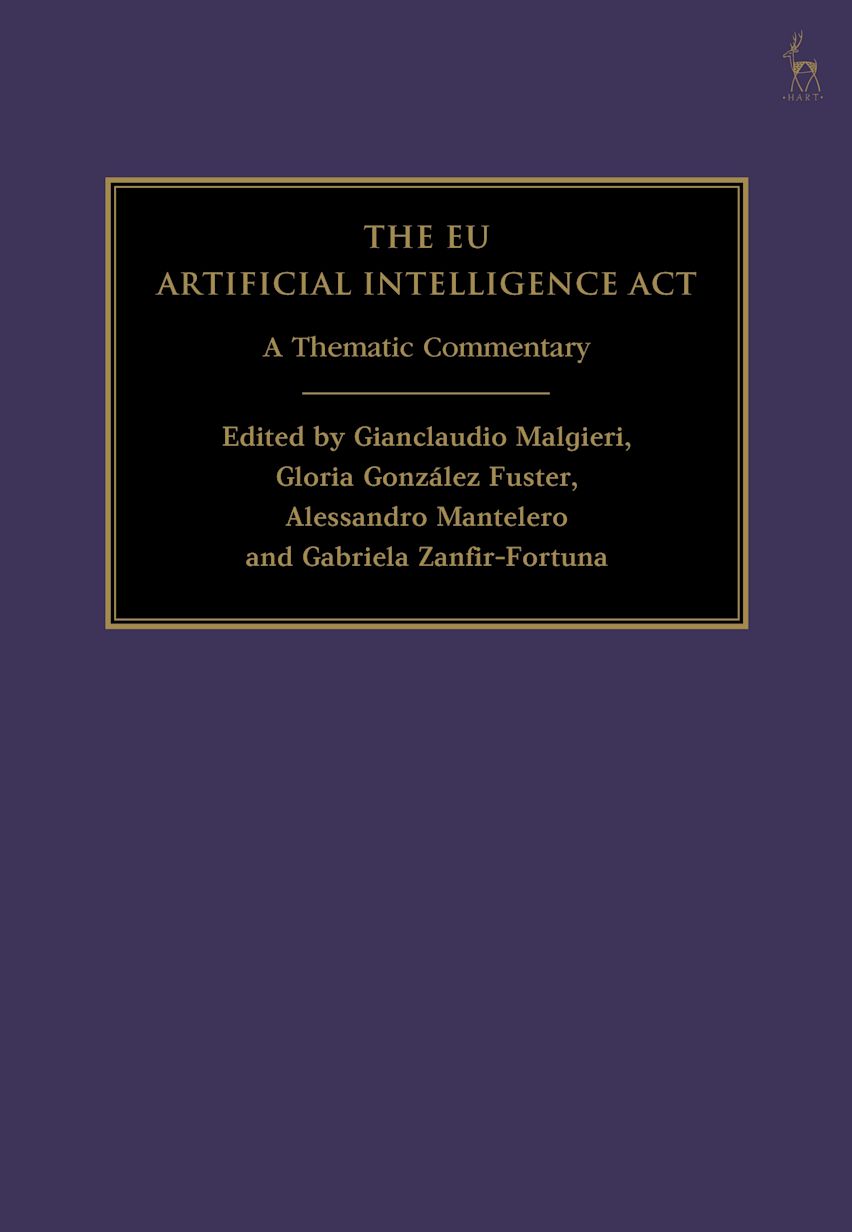
The EU Artificial Intelligence Act
A Thematic Commentary
Payment for this pre-order will be taken when the item becomes available
Description
This thematic commentary analyses the core provisions and overarching themes of the EU Artificial Intelligence (AI) Act to provide readers with the information needed to understand, situate and implement this new piece of legislation in their practice.
The book offers a rich variety of views on one of the most challenging legal innovations of EU law. It analyses individual provisions exhaustively, where their relevance and complexity require specific analysis to guide their implementation, and thematically, where beneficial for a broader view of some of the strategic axes of the Act. Importantly, the chapters unpack connections both within the various components of the EU AI Act itself, as well as with the other key instruments such as the Digital Services Act (DSA), the Digital Markets Act (DMA) and the General Data Protection Regulation (GDPR).
The Thematic Commentary thus provides in-depth coverage of key aspects of the EU AI Act, including detailed reviews of rules on prohibited practices, high-risk AI systems, governance structures, measures to support innovation such as regulatory sandboxes, or codes of conduct.
Written by a curated selection of authors that include renowned academics, global practitioners, and institutional experts involved in the drafting process, this Commentary is a key authoritative source bringing together many different voices. Whether for legal practitioners seeking insights into the practical implementation of the EU AI Act, scholars, regulators and policymakers who need to understand the theoretical and policy implications of the Act, or students looking for an advanced analysis of the EU AI Act in context, this Thematic Commentary is the guiding reference on AI regulation in the EU.
Table of Contents
Part I: Key Issues
1. Why the EU AI Act: The Objectives of the Law, Gianclaudio Malgieri (Leiden University, the Netherlands)
2. The Scope of the AI Act in the Light of the EU's Digital Strategy (Art 2), Alessandro Mantelero (Politecnico di Torino, Italy)
3. Defining AI Regulation: Main Actors and Key Notions (Definitions) (Art 3), Gabriela Zanfir-Fortuna (Future of Privacy Forum, USA)
4. The Risk Framework in the AI Act and the Role of the EC (Article 6,7, Annex I, Annex III, Article 50, Art 9), Laura Caroli (Center for Strategic and International Studies, USA)
5. The Mixed Nature of the AI Act: Product Safety and Fundamental Rights Regulation, Giovanni De Gregorio (Católica Global School of Law, Portugal) and Marco Almada (University of Luxembourg)
Part II: Prohibited Practices
6. The Prohibitions Related to Human Vulnerabilities and Manipulation (Art 5.1.a, 5.1.b), Maria-Lucia Rebrean (Leiden University, the Netherlands) and Silvia De Conca (Vrije Universiteit Amsterdam, the Netherlands)
7. The Prohibitions of Social Scoring (Art 5.1.c), Nathan Genicot (Vrije Universiteit Brussel, Belgium)
8. Prohibition on Predictive Policing (Art. 5.1.d) and Facial Recognition (Art. 5.1.e), Bart Custers (Leiden University, the Netherlands)
9. Prohibition on Emotion Recognition Systems in Education and in the Workplace (Art 5.1.f), Andreas Häuselmann (Open Universiteit, the Netherlands)
10. The Prohibitions Related to Biometric Surveillance and their Exceptions (5.1.e, 5.1.g., 5.1.h., 5.2. ), Gavin Robinson (Leiden University, the Netherlands)
Part III: High-Risk AI Systems
11. Classification of High-Risk AI Systems and its Update (Art 6, 7, 50, 71, Annex I, Annex III), Giorgio Resta (Rome Tre University, Italy) and Cristina Frattone (Roma Tre University, Italy)
12. Obligations of Providers of High-Risk AI Systems (Art 8, Article 9, 16, 20, 21, 22), Phil Lee (Digiphile, UK)
13. Deployers: Identification and Obligations (Art 26), Phil Lee (Digiphile, UK)
14. Conformity Assessment, Quality and Risk Management Systems (Art 8, 9, 17, 42, 43, 46), Alessandro Mantelero (Politecnico di Torino, Italy)
15. The FRIA (Art 27), Alessandro Mantelero (Politecnico di Torino, Italy)
16. Data and Data Governance (Art 10), Margo Bernelin (Centre National de la Recherche Scientifique, France) and Michaël Van den Poel (Eubelius, Beligum)
17. Accountability and Transparency (Art 11, 12, 13, 18, 19, 50), Anda Bologa (Center for European Policy Analysis, USA)
18. Human Oversight, Melanie Fink (Leiden University, the Netherlands)
19. Accuracy, Robustness, and Cybersecurity (Art 15), Giuseppe Vaciago (42Law Firm, Austria; Politecnico di Torino, Italy)
20. Identification and Obligations of Importers, Distributors, and Responsibilities Along the AI Value Chain (Art 23, 24, 25), Bart Schermer (Leiden University, the Netherlands)
21. Standards and Common Specification (arts 40, 41), Irene Kamara (Tilburg University, the Netherlands)
Part IV: GPAI and General-Purpose AI Models
22. The Obligations of Providers of General-Purpose AI Models (Articles 53, 54 and 56), Michael Veale (University College London, UK) and Joao Quintais (University of Amsterdam, the Netherlands)
23. General Purpose AI Models with Systemic Risks. Classification and Specific Obligations (Art 51, 52, 55), Connor Dunlop (Lucid Computing, USA)
Part V: Measures in Support of Innovation
24. AI Regulatory Sandboxes (Art 57-61), Thiago Guimaraes Moraes (Brazilian Data Protection Authority, Brazil)
25. SMEs and Derogation (Art 62, 63), Vincenzo Tiani (Future of Privacy Forum, USA)
Part VI : Governance
26. EU Level Governance (AI Office, AI Board, Advisory Forum, Scientific panel) (Art 64 - 69), Claudio Novelli (Yale University, USA)
27. National Level Governance (National Competent Authorities) and Notification Procedures (incl. Arts 30-31 & 28-39) (Art 70), Joanna Mazur (University of Warsaw, Poland)
Part VII: Monitoring and Enforcement
28. Post-Market Monitoring (Art 72, 73), Brenda Leong (Luminos.law, USA)
29. Enforcement (Art 74 - 84, 88 - 94), Luca Tosoni (Schjødt, formerly Norwegian Data Protection Agency, Norway)
30. The Right to Explanation (Art 86), Margot Kaminski (University of Colorado Law School, USA) and Gianclaudio Malgieri (Leiden University, the Netherlands)
31. Remedies and Penalties (Art 85, 87, 99 - 101), Maria Magierska (Maastricht University, the Netherlands)
Part VIII: Codes of Conducts, Guidelines and AI Literacy
32. Codes of Conduct and EC Guidelines (Art 56, 95-98), Denise Amram (Scuola Superiore Sant'Anna, Italy) and Roberta Romano (Scuola Superiore Sant'Anna, Italy)
33. AI Literacy (Art 4), Tommaso Fia (University of Tübingen, Germany)
Part IX : The AI Act Interactions with the Digital Rulebook
34. Consistency and Interplay with the GDPR, Gloria González Fuster (Vrije Universiteit Brussel, Belgium)
35. Consistency and Interplay with the DSA, Gianclaudio Malgieri (Leiden University, the Netherlands)
36. The AI Act, the Proposed AI Liability Directive, and the Product Safety Directive, Gianmarco Gori (Vrije Universiteit Brussel, Belgium)
37. The Interplay Between the DMA and the AIA, Muhammed Demircan (DLA Piper, USA), Osman Gazi Gucluturk (Galatasaray University, Turkey), and Heidi Waem (DLA Piper, USA)
Product details
| Published | May 14 2026 |
|---|---|
| Format | Ebook (PDF) |
| Edition | 1st |
| Extent | 784 |
| ISBN | 9781509988587 |
| Imprint | Hart Publishing |
| Publisher | Bloomsbury Publishing |
Related Titles