

Buying pre-order items
Ebooks and Audiobook
You will receive an email with a download link for the ebook or audiobook on the publication date.
Payment
You will not be charged for pre-ordered books until they are available to be shipped. Pre-ordered ebooks will not be charged for until they are available for download.
Amending or cancelling your order
For orders that have not been shipped you can usually make changes to pre-orders up to 72 hours before the publishing date.
Payment for this pre-order will be taken when the item becomes available
- Delivery and returns info
-
Free CA delivery on orders $40 or over
Description
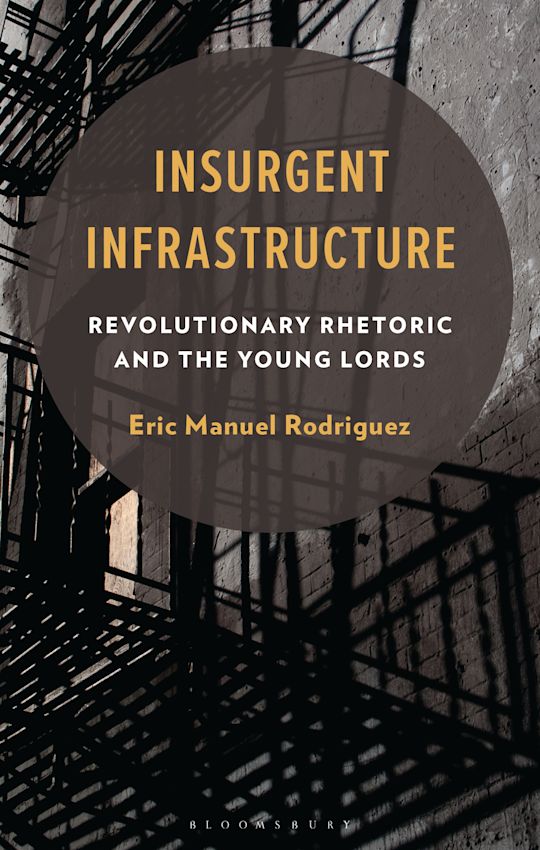
In this book, Eric Manuel Rodriguez argues that revolutionary rhetoric operates as insurgent infrastructure rather than symbolic performance.
Examining the Young Lords, a revolutionary nationalist organization forged from conditions of colonial displacement, racial capitalism, and urban neglect, this book argues that rhetorical studies requires recalibration to account for rhetoric's material dimensions and its capacity to coordinate collective survival under organized abandonment. Through sustained analysis of the Young Lords' bilingual newspaper Palante, their 13-Point Program and Platform, Rules of Discipline, and the occupations, clinics, and educational programs that constituted their revolutionary praxis, Rodriguez demonstrates how rhetoric coordinated bodies, resources, and time under conditions of organized abandonment.
Drawing on decolonial theory, foquismo, and the concept of kairos, the study reframes rhetorical action as the construction of counter-institutions – free clinics, autonomous media, community defense, liberation school – that sustained collective survival. Tracing the organization's rhetorical evolution from Chicago to New York and its eventual fracture, the book reveals how print, pedagogy, and occupation functioned as logistical media for mobilization.
Ultimately, Rodriguez concludes by articulating three principles – insurgent infrastructure, dialectical pedagogy, and collective logistics – that connect the Young Lords' legacy to contemporary movements and abolitionist organizing.
Table of Contents
1. The Young Lords: A Blueprint for Rhetorical Resistance
2. Revolutionary Timing: Foquismo, Kairos, and the Seizure of Conjuncture
3. Print as Logistics, Not Symbolism
4. Rhetorical Fracture: Geography, Ideology, and the Split
5. Revolutionary Rhetoric and the Work of Liberation
Epilogue: Writing as Action: Revolutionary Incompleteness and the Rhetoric of the Present
Bibliography
Index
About the Author
Product details

| Published | Nov 12 2026 |
|---|---|
| Format | Hardback |
| Edition | 1st |
| Pages | 192 |
| ISBN | 9781666981681 |
| Imprint | Bloomsbury Academic |
| Dimensions | 229 x 152 mm |
| Publisher | Bloomsbury Publishing |
Related Titles