
Payment for this pre-order will be taken when the item becomes available
Description
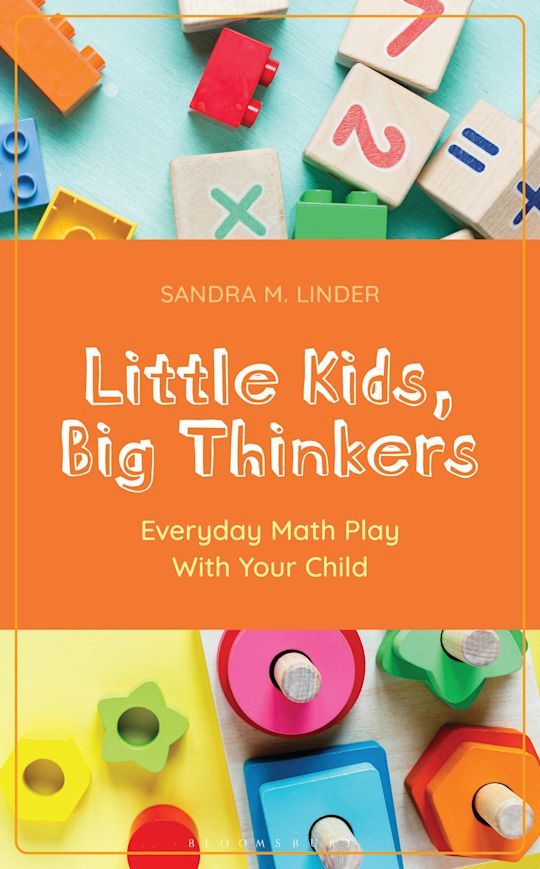
While we often think of mathematics as a “school age subject”, this interactive guide shows how you can encourage mathematical problem-solving in your child at a very young age through play and everyday interactions.
Children are big thinkers and can do pretty amazing things. As you delve into the world of mathematical play, you will help your child not only explore skills like counting and comparing, measuring, and creating patterns, but also learn to ask questions, develop resilience and persistence when presented with challenges, and increase confidence through exploration and reflection.
These early moments of play and discovery, side by side with you as their guide, lay the foundation for lifelong problem solving and reasoning abilities. You are not just supporting their mathematics development; you are setting the stage for your child to be a change-maker as they grow.
Table of Contents
Chapter 1: Math before Kindergarten? They are Too Young! What is Early Math?
Chapter 2: What Does Math Look Like at This Age? Processes in Early Math
Chapter 3: My Kid Can Barely Count to Three! Content in Early Math
Chapter 4: Wait There's More? Moving Beyond Number: Exploring Geometry, Measurement, Data Analysis, and Algebra for Young Children
Chapter 5: Putting it All Together: The Role of the Parent in Supporting your Child's Learning
Part II: Recipes for Success: Doing Mathematics With Your Child Each Day
Chapter 6: Wait! We Have to Do this Every Day? Finding the Math around Your Home
Chapter 7: Let's Take This on the Road! Finding the Math in Your Travels
Chapter 8: Beyond Everyday Routines: Family Mathematical Tasks Suggestions, Ideas, and Sample Tasks
Chapter 9: Connecting to the Classroom: Taking Mathematical Tasks Even Further
Chapter 10: Troubleshooting Tips
Product details

| Published | Sep 03 2026 |
|---|---|
| Format | Ebook (Epub & Mobi) |
| Edition | 1st |
| Extent | 176 |
| ISBN | 9798765159927 |
| Imprint | Bloomsbury Academic |
| Illustrations | 13 b/w figures |
| Publisher | Bloomsbury Publishing |
Reviews
Related Titles