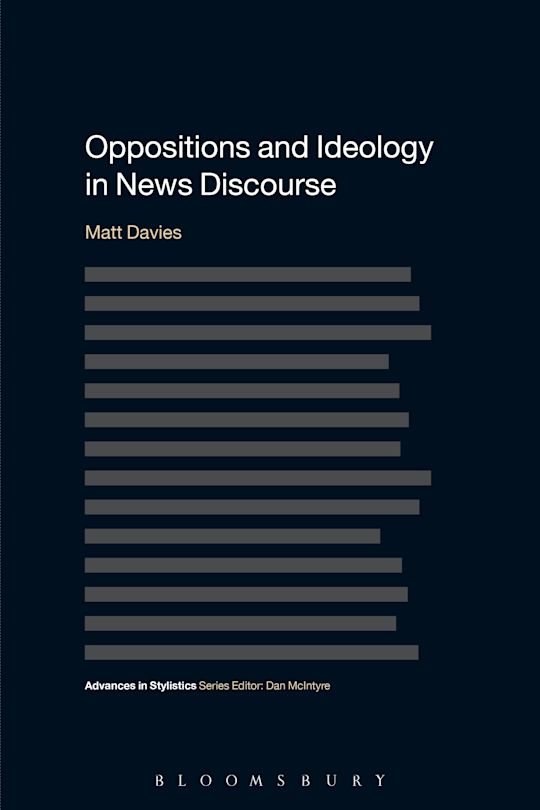

Oppositions and Ideology in News Discourse
For information on how we process your data, read our Privacy Policy
Description
Constructed opposition has proved as viable an area of
research as traditional antonymy, and a useful tool in looking at ideologically
orientated texts. This book investigates
how binary oppositions are constructed discursively and the potential
ideological repercussions of their usage in news reports in the British press.
The focus is particularly on the positive presentation of
groups and individuals subsumed under the first person plural pronouns 'us' and
'we', and the simultaneous marginalization of groups designated as 'they' or
'them'. Exploring the dynamic relations between the linguistic system and
language in context this is a key publication for those involved in discourse
analysis and stylistics.
Table of Contents
Case study 1: The ideological
function of clustered oppositions in the representation of anti-war protestors
\ 6. Case Study 2: A comparison of the role of
constructed oppositions in two news reports of a Countryside Alliance protest
march \ 7. Consistent oppositional themes in the protest march data \ 8. A new approach to studying binary oppositions in the construction of 'us' and 'them' in news texts \ Bibliography \ Index
Product details

| Published | Nov 22 2012 |
|---|---|
| Format | Ebook (Epub & Mobi) |
| Edition | 1st |
| Extent | 256 |
| ISBN | 9781441160447 |
| Imprint | Bloomsbury Academic |
| Series | Advances in Stylistics |
| Publisher | Bloomsbury Publishing |
Reviews
Related Titles