Digital Intermediaries in Domestic and Care Work
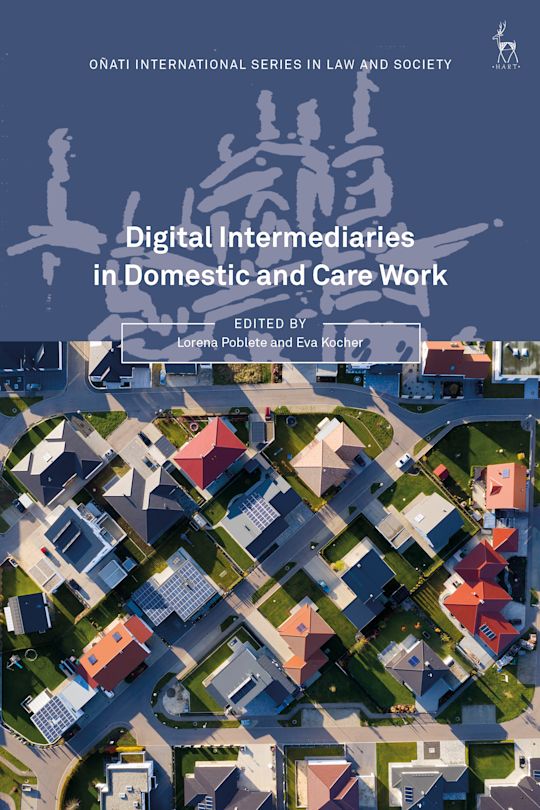


Digital Intermediaries in Domestic and Care Work
Description
This edited collection unravels the multiple ways in which digital intermediaries have transformed the domestic and care work sector – and what this development entails for the regulation of digital labour platforms.
Domestic and care work is work like any other – but also work like no other. As a consequence, digital intermediaries in these sectors fulfil partly different functions than other digital labour platforms. Taking a comparative and interdisciplinary socio-legal approach, the book is organised into four parts. The first section describes the different business models used in various geographical areas and analyses the ways in which digital intermediaries reshape these markets. The second section examines how digital intermediaries adapt their structures and organisations to regulatory and institutional frameworks, while also exploiting regulatory gaps and grey zones. The third part of the book highlights the experiences of domestic workers who develop novel forms of platform cooperatives with the potential for better working conditions and a stronger voice. The fourth part of the books looks at the legal and regulatory challenges, discussing the challenge of classifying digital intermediation in care and domestic work not only in relation to employment/self-employment, but also in relation to the third party in the triangular relationship: the private household. The book analyses cases from South and Central Europe, Southeast Europe, the UK, South Africa and Latin America; its interdisciplinary approach, with sociological, anthropological and legal perspectives make the book an important reference in this emerging field of study.
Accessibility Information
Additional accessibility information
- EPUB 3.0
- Conforms with the requirements of EPUB Accessibility Spec v1.1
- WCAG level AA
- WCAG v2.2 compliant
- accessibility@bloomsbury.com
Hazards
The publication contains no hazards
Support for non-visual reading
- No accessibility features offered by the reading system, device or reading software are disabled or otherwise unusable with the product
- Has alternative text descriptions for images
Visual adjustments
Appearance of the text and page layout can be modified according to the capabilities of the reading system (font family and size, spaces, as well as color of background and text)
Navigation
- Page list to go to pages from the print source version
- Elements such as headings, tables, etc for structured navigation
- All or substantially all textual matter is arranged in a single logical reading order
- Content is enhanced with ARIA roles to optimize organization and facilitate navigation
- Purposes of all links are made clear
Rich content
Language tagging provided
Table of Contents
Part I: Emerging Models at National Level
1. The Emergence of Platforms in Care and Domestic Services in Spain: An Exploration of their Business and Growth Models, Paula Rodríguez-Modroño (Pablo de Olavide University, Spain)
2. Between Formal and Informal Work? Analysing Insertion Strategies of Digital Platforms in the French Domestic Services Market, Nicole Teke-Laurent (Nanterre University, France)
3. Peer-to-Peer Precarity: The Role of Multi-Service Platforms in Shaping Wages and Working Conditions in Belgium, Mat Johnson (Alliance Manchester Business School, UK), Valeria Pulignano, Claudia Marà and Milena Franke ((KU Leuven, Belgium)
Part II: Adaptations to Legal Frameworks from a Comparative Perspective
4. Business as Usual? Strategic Adaptation and Effects on Labour Formalisation in Domestic Work Platforms in Southeast Europe, Jelena Starcevic (Cornell University, USA)
5. Within and Without the Margins of the Law. Digital Intermediaries in Domestic Work in Latin America, Lorena Poblete (Universidad Nacional de San Martín, Peru)
6. Care Regimes and Industrial Relations: A Comparison of the Factors Shaping the Emergence of Digital Platforms in the Domestic Sector in Ireland and Italy, Ivana Pais (Università Cattolica del Sacro Cuore, Italy), Caroline Murphy and Tish Gibbons ((University of Limerick, Ireland)
Part III: An Alternative Model: Workers' Cooperatives
7. Towards Transition from an Academic Project to WeCare Workers Enterprise: Lessons from the Digital Platform Cooperative Project (DPCP), South Africa, Abigail Osiki (University of Canterbury, New Zealand)
8. Giving Cleaning Work the Value it Deserves: The Potential of Platform Cooperatives to Advance Fair Work and Self-Determination, Joanna Bronowicka (European University Viadrina, Germany), Barbara Orth (University of Bern, Switzerland) and Sabri Schumacher (Autonomía, Switzerland)
Part IV: Regulating Digital Intermediaries in Europe
9. Domestic Platform Work as a Multiparty Relationship: Regulatory Loopholes and Ways to Address Them, Christina Hießl (KU Leuven, Belgium)
10. Legal Models of Labour Intermediaries and Digital Care Platforms, Luca Ratti (University of Luxembourg)
11. House of Gigs: Domestic Workers, Algorithmic Management and the Platform Work Directive, Antonio Aloisi (IE University Law School, Spain) and Nastazja Potocka-Sionek (University of Luxembourg)
12. Platform Domestic and Childcare Work: Centring Labour Rights in the Formalisation Debate, Natalie Sedacca (University of Durham, UK) and Joe Atkinson (University of Southampton, UK)
Product details
| Published | 23 Jul 2026 |
|---|---|
| Format | Ebook (Epub & Mobi) |
| Edition | 1st |
| Pages | 336 |
| ISBN | 9781509990863 |
| Imprint | Hart Publishing |
| Series | Oñati International Series in Law and Society |
| Publisher | Bloomsbury Publishing |


Related Titles