Qajari Social Contract
An English translation and Persian edition of Mirza Aqa Khan Kermani's 'Takvin va Tashri'
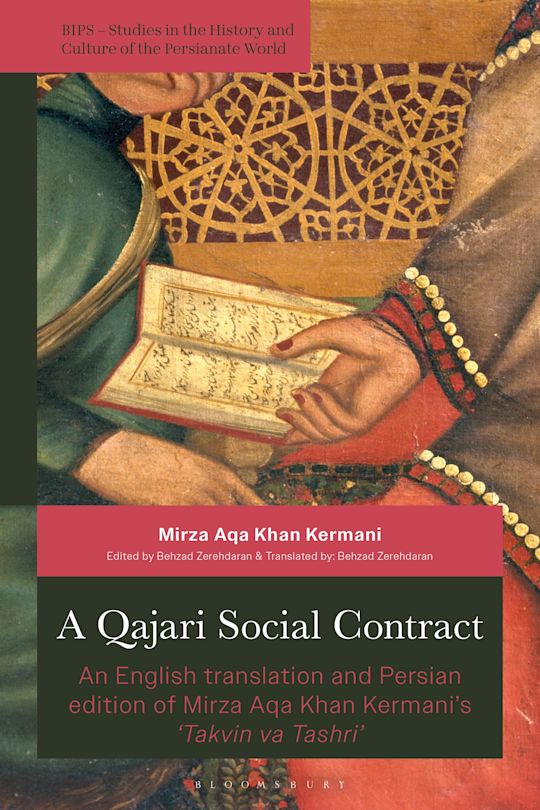

Qajari Social Contract
An English translation and Persian edition of Mirza Aqa Khan Kermani's 'Takvin va Tashri'
Description
This volume presents the first-ever Persian edition and English translations of Mirza Aqa Khan Kermani's Takvin va Tashri (Genesis and Canonical Lawgiving).
Mirza Aqa Khan Kermani (1854-1896) was an Iranian intellectual, philosopher and secular nationalist whose iconoclastic ideas about modernisation and opposition to the Qajar monarchy would be taken up during the Constitutional Revolution and by later thinkers such as Ahmad Kasravi. In this book, Kermani argues for an evolutionary understanding of the origins and roles of societal institutions and divine ideas, presenting the concept of God as a psychological projection. With a critical commentary that places Kermani's ideas in the context of Qajar-era Iran, this important primary source will be of value to scholars and students of Iranian intellectual history.
Accessibility Information
Additional accessibility information
- PDF/UA-2, 1.4
- accessibility@bloomsbury.com
Hazards
The publication contains no hazards
Support for non-visual reading
Has alternative text descriptions for images
Navigation
- Page list to go to pages from the print source version
- Elements such as headings, tables, etc for structured navigation
- All or substantially all textual matter is arranged in a single logical reading order
Table of Contents
Introduction
A Tale of Three Cities: The Intellectual Life of Mirza Aqa Khan Kermani
1. Introduction: Infinite Pages of a Revolution
2. Kerman: The Making of an Intellectual Dissident
2.1. Birth and Lineage
2.2. Formative Environment of Kerman
2.3. Education and Teachers
2.4. Conflict and Flight
3. Isfahan: Between Patronage and Peril
3.1. Reformist Circles and Court Intrigues
3.2. Tehran Interlude and the Road to Exile
4. Istanbul: Between Flourishing and Perishing
4.1. Sympathy With the Azali Cause: Cyprus, Marriage, and Melancholy
4.2. The Birth of an Author: Rezvan and Early Literary Experiments
4.3. Three Mirrors of Azali Thought: Hekmat-e Nazari (Theoretical Philosophy), Haftad-o-do Mellat (Seventy-Two Sects), and Hasht Behesht (Eight Paradises)
4.4. Journalism and Reform: Akhtar and the Tobacco Crisis
4.5. Recognition and Stability
4.6. In the Circle of Dissidents: Mirza Habib Esfahani
4.7. Azali Exposure and Exclusion in Exile
4.8. Reading the Enlightenment
4.9. In the Circle of Dissidents: Mirza Malkom Khan and Seyyed Jamal al-Din Afghani
4.10. Extradition and Aftermath
The Fading Shadow of God: On Atheology and the Death of the Sacred in Takvin va Tashri
1. The Genealogy of Disbelief: From Ilhad to Atheology
2. The Poetics of Heterodoxy: Literature as Humanist Resistance
3. The Clerical Hegemony of Safavid Shi'ism
4. The Fracturing of the Divine Order: Literature and the Poetics of Denial
5. The Birth of the Intellectual Amid the Twilight of Qajar Absolutism
6. Theoretical Framework: The Unthought and the Logosphere
7. Reading Takvin va Tashri: The Genesis of Fear and the Contract of Religion
8. Prophecy, Power, and the Social Contract
9. The Tongue of Nature: Prophecy Without Revelation
10. The Fusion of Horizons: Kermani in Dialogue with Durkheim, Montesquieu, and Ibn Khaldun
11. Concluding Remarks: Toward a Natural Atheology
Takvin va Tashri
The First Ray: On the Weakness and Infirmity of Man, and the Intensity of His Helplessness and Dependence
The Second Ray: On the Formation of Human Societies After the State of Fear
The Third Ray: On the Trajectory of Man in His Original Course
The Fourth Ray: On the Organisation of Man's Livelihood Within Society
The Fifth Ray: On the Emergence of Sciences, Arts, and Crafts in Accordance With the Needs and Exigencies of Human Life
The Sixth Ray: On the Origin of Language and Speech
The Seventh Ray: On the Origin of Script and Writing, and the Invention of Numerals and Letters
The Eighth Ray: On the Nature of Poetry, Music, Painting, and Related Arts
The Ninth Ray: On the Art of Medicine, Veterinary Practice, and Surgery
The Tenth Ray: On War, Its Instruments, and the Enhancement of Martial Power
The Eleventh Ray: On the Relations and Exchanges of Estates, Commerce, Cultivation, and Industry
The Twelfth Ray: On the Origin of the Science of Astronomy, Judicial Astrology, the Horoscope, and the Celestial Tables
The Thirteenth Ray: On the Origins of Geometry, Arithmetic, Jarr al-Asqal (the Science of Moving and Balancing Heavy Bodies), and Avfaq (Magic Squares or Numerical Talismanic Tables)
The Fourteenth Ray: On the Origins of Seafaring and Other Western Discoveries
The Sixteenth Ray: On Prophetic Power, Kingship, Wisdom, and the Formation of the Civilised World
The Seventeenth Ray: On Man in Pursuit of First Causes, and the Inquiry into and Division of Philosophy
The Eighteenth Ray: On the Manner of the Emergence of Prophets, Priests, and the Talmud Among the Israelites
The Nineteenth Ray: On the Manner of Worship and the Origins of Idolatry
Glossary
Bibliography
Product details

| Published | 26 Nov 2026 |
|---|---|
| Format | Ebook (PDF) |
| Edition | 1st |
| Pages | 240 |
| ISBN | 9780755659036 |
| Imprint | Bloomsbury Academic |
| Series | British Institute of Persian Studies |
| Publisher | Bloomsbury Publishing |
Related Titles