Hindus, Jews, and the Politics of Comparison
Embodied Communities and Models of Religious Tradition
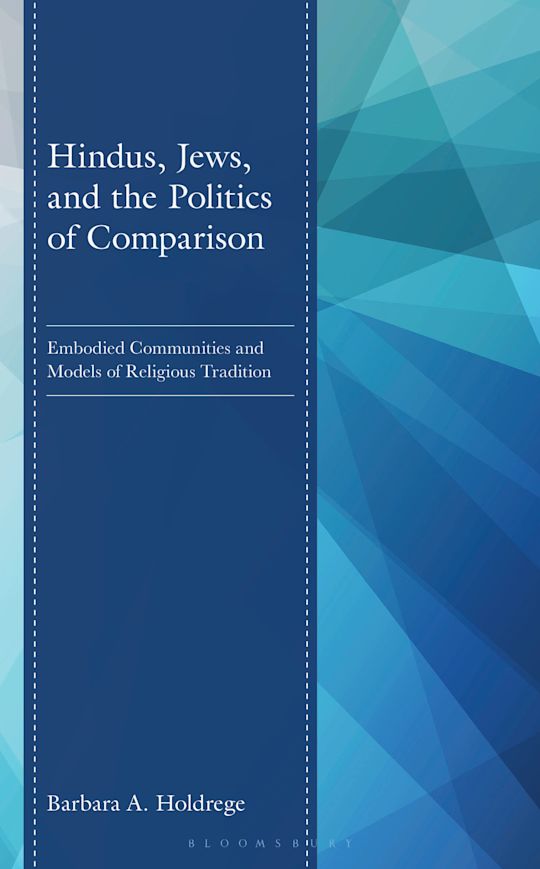

Hindus, Jews, and the Politics of Comparison
Embodied Communities and Models of Religious Tradition
Buying pre-order items
Ebooks and Audiobook
You will receive an email with a download link for the ebook or audiobook on the publication date.
Payment
You will not be charged for pre-ordered books until they are available to be shipped. Pre-ordered ebooks will not be charged for until they are available for download.
Amending or cancelling your order
For orders that have not been shipped you can usually make changes to pre-orders up to 72 hours before the publishing date.
Payment for this pre-order will be taken when the item becomes available
- Delivery and returns info
-
Free UK delivery on orders £30 or over
Description
In Hindus, Jews, and the Politics of Comparison: Embodied Communities and Models of Religious Tradition, Barbara A. Holdrege emphasizes the role of comparative study as a method of critical interrogation that can serve as a means to challenge hegemonic taxonomies and categories in the academy and to reconstitute our scholarly discourse to allow for a multiplicity of epistemologies. Holdrege provides an extended series of reflections on the politics, problematics, and dynamics of comparison in which she explores how certain analytical categories in the study of religion-such as the body, scripture, sacrifice, purity, and food-can be fruitfully reimagined through a comparative analysis of their Hindu and Jewish instantiations. The author argues that this re-visioning of analytical categories through sustained comparative historical studies of a range of Hindu and Jewish traditions can provide the basis for generating alternative imaginaries to the prevailing Eurocentric and Protestant-based paradigms in the academy that have perpetuated the ideals of Enlightenment discourse and colonial and neocolonial projects. Such studies can serve as an important corrective to the scholarly practices through which certain categories and models have been privileged over others in the social sciences and humanities and in religious studies more specifically.
Table of Contents
Introduction
1: The Politics of Comparison: Beyond the Tyranny of Taxonomies
South Asia and the Middle East: Beyond European Hegemony
Hinduisms and Judaisms: Beyond Protestant Christian Hegemony
2: What Have Hindus to Do with Jews? Hindu-Jewish Encounters in the Academy and Beyond
Historical Encounters: South Asian and Middle Eastern Cultures, Indic and Judaic Worlds
Collaborative Scholarly Encounters: Comparative Studies of Hindu and Jewish Traditions
Interreligious Encounters: Hindu-Jewish Dialogue
3: Veda and Torah: Textual Communities and the Word Beyond Text
From Text to Symbol
I. Veda
II. Torah
III. Veda and Torah
Reimagining Scripture
4: Models of Religious Tradition: Embodied Communities and Missionizing Traditions
Embodying Ethnocultural Identities
Missionizing Traditions and Universalizing Projects
5: The Gastrosemantics of Hindu and Jewish Foodways: Food Taxonomies, Dietary Regimes, and Socioreligious Hierarchies
Embodied Communities and Foodways
Food Taxonomies and Animal Classifications
Dietary Regulations and Social Classifications
Food Preparation and Food Transactions
Afterword
From the Locative/Utopian Dichotomy to the Dialectic of Local Histories/Global Designs
Embodied Communities and Missionizing Traditions
Note on Translations and Transliteration
Notes
Bibliography
About the Author
Product details

| Published | 11 Jun 2026 |
|---|---|
| Format | Hardback |
| Edition | 1st |
| Pages | 312 |
| ISBN | 9781666932157 |
| Imprint | Bloomsbury Academic |
| Illustrations | 6 BW Illustrations, 2 Tables |
| Dimensions | 229 x 152 mm |
| Series | Studies in Comparative Philosophy and Religion |
| Publisher | Bloomsbury Publishing |
Reviews

ONLINE RESOURCES
Bloomsbury Collections
This book is available on Bloomsbury Collections where your library has access.
Related Titles