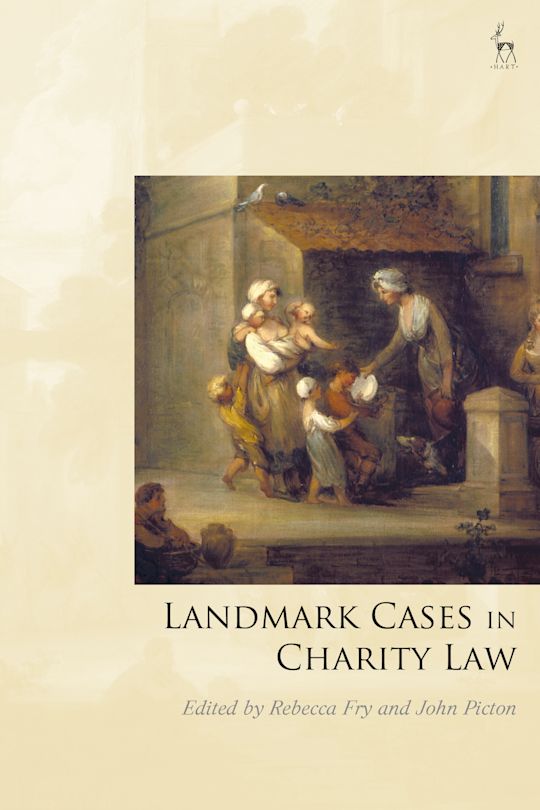

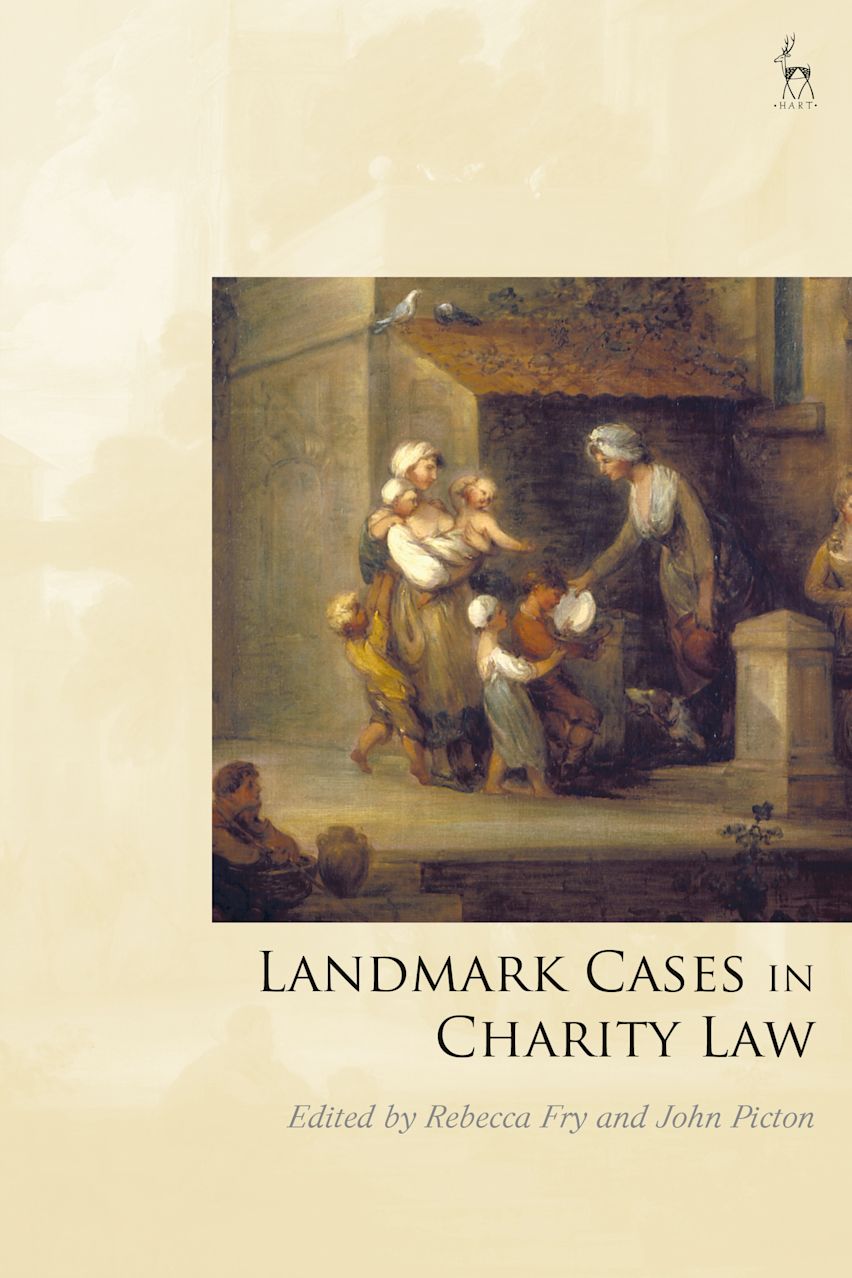
Landmark Cases in Charity Law
Payment for this pre-order will be taken when the item becomes available
Description
Part of the iconic Landmark Cases series, this book brings the most significant cases in charity law together for the first time.
More than four hundred years have passed since the concept of charity was first given statutory legal form in England in the Statute of Charitable Uses of 1601. This book explores the substantial body of judge-made rules and principles developed since then, highlighting a carefully curated selection of the landmark cases which have shaped charity law. Each chapter analyses one or more judicial decisions, setting them in their historical context, explaining their contemporary importance, and considering their future relevance.
The selected cases cover a broad range of topics. Some go to the heart of what it means to be a charity, elucidating charity's legal definition and public benefit requirement. Others demonstrate how charity law has been shaped by its interaction with other bodies of law, including trust law, company law and equality law, and by emerging tensions between trustees' overriding duty to further the charity's purposes and broader moral obligations or ethical considerations.
The book has a core focus on English precedents, but the cases are touchstones in many jurisdictions. Our contributors therefore include scholars, judges and practitioners from Australia, Canada, New Zealand and Singapore, as well as from the UK. The result is a book that sheds new light on the application and development of charity law's defining rules and principles across the common law world.
Table of Contents
ii Foreword, Lady Arden of Heswall
iii Preface, Rebecca Fry and John Picton
iv Contributors
v Table of Cases
vi Table of Legislation
1. Jones v Williams (1767): The First Definition of Charity, Jonathan Garton (University of Warwick, UK)
2. Attorney General v Kell (1840) and Attorney General v Earl of Craven (1856): Recovery of Misapplied Charitable Property and its Cy-près Application, Charles Mitchell (University College London, UK)
3. Defining Charity: Commissioners for Special Purposes of the Income Tax v Pemsel (1891), Ian Murray (University of Western Australia)
4. Re Wilson (1913): Framing the General Charitable Intention, John Picton (University of Manchester, UK)
5. Gilmour v Coats (1949): Judging Religion's Public Benefit, Kathryn Chan (University of Victoria, Canada)
6. Oppenheim v Tobacco Securities Trust Co Ltd (1950): The Personal Nexus Test, Lara McMurtry (University of Sussex, UK)
7. Inland Revenue Commissioners v Baddeley (1955): Public Benefit and the Fourth Head, Lord Justice Newey (Court of Appeal of England and Wales)
8. In Re Resch Will's Trust (1967): Charities Which Charge for Their Services, Lord Sales (Supreme Court of the United Kingdom)
9. Re Snowden (1969): The Discovery of the Ex Gratia Jurisdiction, Jonathan Fowles (Serle Court, UK)
10. Liverpool and District Hospital for Diseases of the Heart v Attorney General (1980), Lord Briggs (Supreme Court of the United Kingdom)
11. McGovern v Attorney General (1981): The Political Purpose Doctrine, Jane Calderwood Norton (University of Auckland, New Zealand)
12. Harries v Church Commissioners for England (1991): Ethical Investment by Charity Trustees, Rebecca Fry (Supreme Court of the United Kingdom)
13. R (Independent Schools Council) v Charity Commission for England and Wales (2011), Robert Pearce (Radcliffe Chambers, UK)
14. Lehtimäki v Cooper (2020), Man Yip and Alvin W-L See (Singapore Management University)
15. The bright lines of R (on the application of Z and Anor) (AP) v Hackney London Borough Council and Anor (2020), Jennifer Sigafoos (University of Liverpool, UK)
Product details
| Published | 12 Nov 2026 |
|---|---|
| Format | Ebook (Epub & Mobi) |
| Edition | 1st |
| Pages | 480 |
| ISBN | 9781509982875 |
| Imprint | Hart Publishing |
| Series | Landmark Cases |
| Publisher | Bloomsbury Publishing |


Related Titles