- Home
- ACADEMIC
- History
- Modern History
- Marketing Literature and Posthumous Legacies
Marketing Literature and Posthumous Legacies
The Symbolic Capital of Leonid Andreev and Vladimir Nabokov
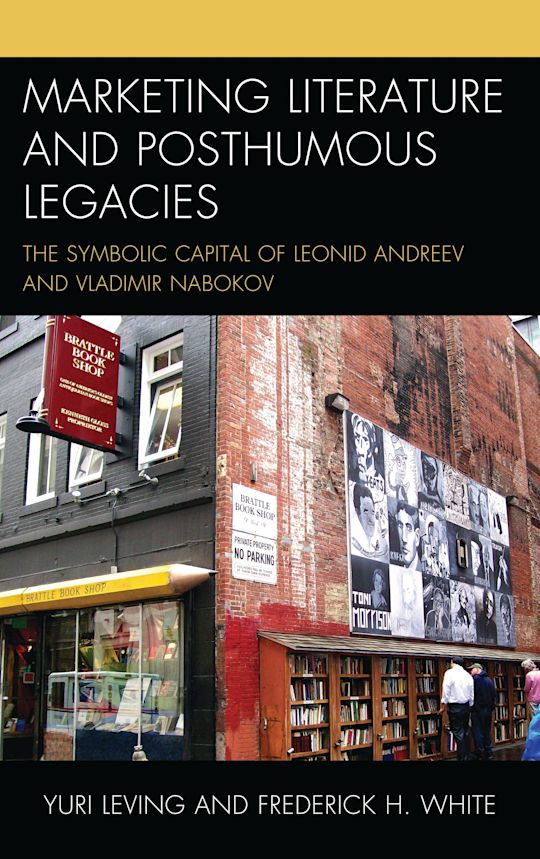
Marketing Literature and Posthumous Legacies
The Symbolic Capital of Leonid Andreev and Vladimir Nabokov

This product is usually dispatched within 10-14 days
- Delivery and returns info
-
Free UK delivery on orders £30 or over
You must sign in to add this item to your wishlist. Please sign in or create an account
Description
Literature is not only about aesthetics, but also almost equally about economics. The successful marketing of an author and his literary works is more dependent on the activities of cultural merchants than on the particular words and phrases found in the author’s prose. Marketing Literature and Posthumous Legacies focuses on the creation of symbolic capital for the literary legacies of Leonid Andreev and Vladimir Nabokov that was eventually exchanged by cultural merchants for financial and ideological profit. Yuri Leving and Frederick H. White discuss the ways in which certain cultural merchants created symbolic meaning for these two authors through a process of collusion, consecration, and the marketing of tangible and intangible products that lead to some sort of transaction. The promotion and maintenance of posthumous legacies involves an intricate network of personal interests that drive the preservation of literary reputations.
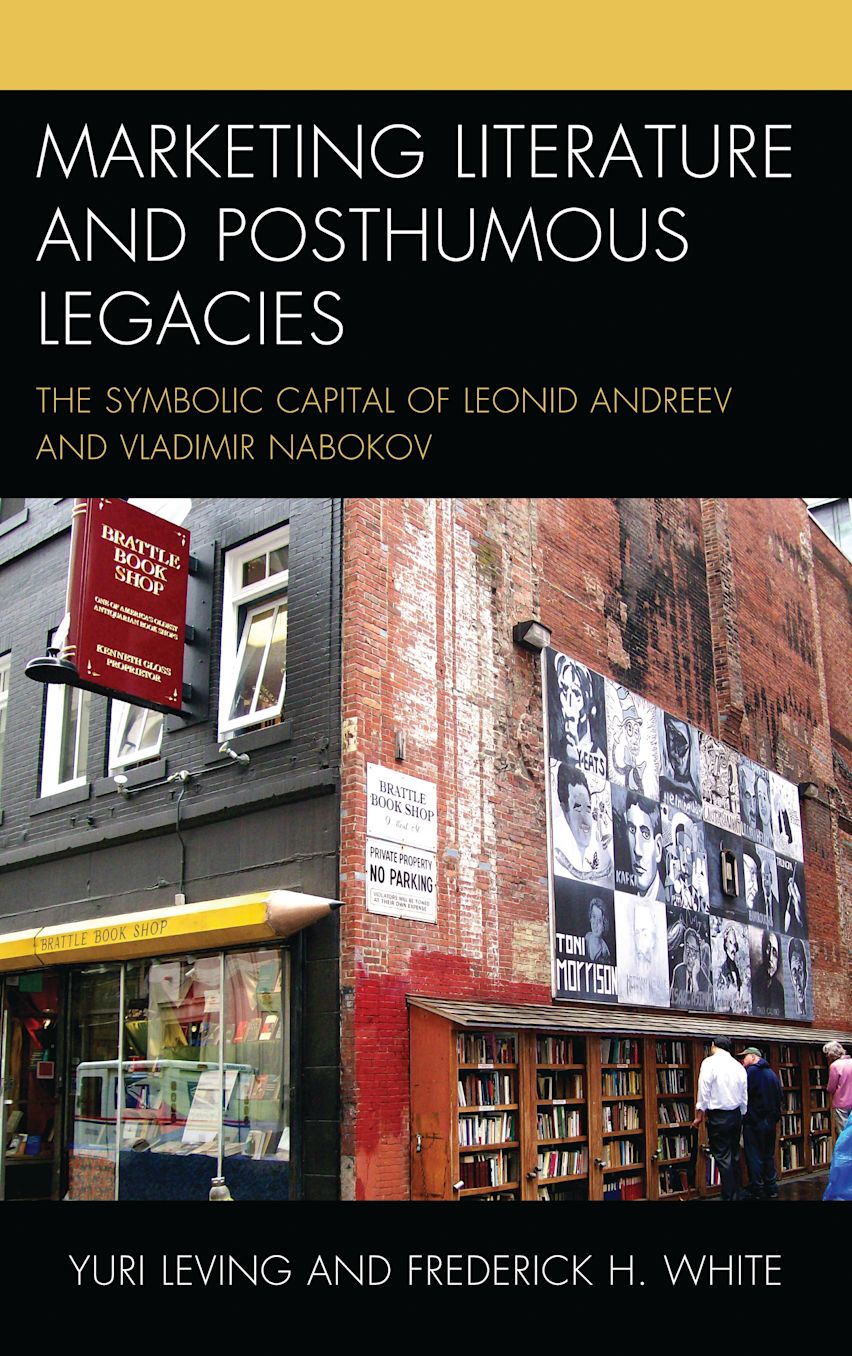
Table of Contents
Introduction
PART I: THE ANDREEVS
Chapter 1: The Early Visual Marketing of Leonid Andreev
Chapter 2: Marketing Strategies:Vadim Andreev in Dialogue with the Soviet Union
Chapter 3: The Role of the Scholar in the Consecration of Leonid Andreev (1950s to present)
Chapter 4: Creating Posthumous Legacies: The Power to Consecrate and to Blaspheme. Vadim Andreev’s Memories of Childhood
Chapter 5: Market Pressures:Vadim Andreev’s Incomplete Memoiristic Journey
PART II: THE NABOKOVS
Chapter 6: Nabokov and the Publishing Business
Chapter 7: Plaster, Marble, Canon: The Vindication of Nabokov in Post-Soviet Russia
Chapter 8: The Visual Marketing of Nabokov: Who is the Face of the Russian Lolita?
Chapter 9: “Nabokov-7”: Russian Postmodernism in Search of a National Identity
Chapter 10: Interpreting Voids: Nabokov’s Last Incomplete Novel, The Original of Laura
Conclusion
Bibliography
About the Authors
Product details
| Published | 12 Sep 2013 |
|---|---|
| Format | Hardback |
| Edition | 1st |
| Extent | 294 |
| ISBN | 9780739182604 |
| Imprint | Lexington Books |
| Illustrations | 50 BW Photos |
| Dimensions | 236 x 157 mm |
| Publisher | Bloomsbury Publishing |

About the contributors
Reviews
-
Frederick H. White and Yuri Leving have joined forces to produce a book devoted to analyzing the preservation and consecration of the literary legacies of Leonid Andreev and Vladimir Nabokov. Their goal is to demonstrate that the underlying economic factors of marketing literature and posthumous legacies are real. One of the book's salient features is to translate this in itself uncontroversial claim into the language of Pierre Bourdieu. This is a study of the production, protection, and transportation of symbolic capital across national and ideological boundaries.
The Russian Review
-
This is a stimulating and lively volume which calls attention to matters that scholars will want to explore in considering the works, the lives, and the legacies of other Russian writers as well.
Slavic and East European Journal
-
This well-researched book comprises two parts, or 'case studies' (10), on Leonid Andreev and Vladimir Nabokov. . . .The adduction of these [cultural economic] theories endows the book with a high degree of analytical rigor and generates a plethora of valuable insights into Andreev’s and Nabokov’s reception in Russia and the west.
Slavic Review
-
This engaging, highly accessible study examines the role of marketing in shaping the legacies of Leonid Andreev and Vladimir Nabokov. The authors take an original approach to literary study by focusing on how these two writers and their friends, family, contemporaries, and rival writers publicized their works, reframing them for diverse audiences while profiting from them economically and professionally. Rather than marginalize these mercantile issues as unworthy of interest in relation to a writer’s aesthetic value, Leving and White convincingly demonstrate that the establishment of what Pierre Bourdieu calls symbolic capital is essential to our appreciation and understanding of literature.
Alexander Burry, The Ohio State University
-
Applying concepts from Pierre Bourdieu's sociology of culture to the careers and posthumous legacies of Andreev and Nabokov, Frederick White and Yuri Leving show how the actual business of culture works: by bypassing aesthetics, the authors aim to show how literary reputations are made by authors, publishers, booksellers, literary executors, academics, and even readers seeking to maximize their 'capital,' either financial or symbolic. The careers of Nabokov and Andreev, two central names in the history of Russian literature of the 20th century, the publication history of their books, and the roles played by their literary executors make for a fascinating and highly enlightening story about an aspect of the culture business that is usually ignored by general readers and academics alike. Highly recommended for anyone interested in modern Russian literature as well as the economics of literature.
Anthony Anemone, The New School