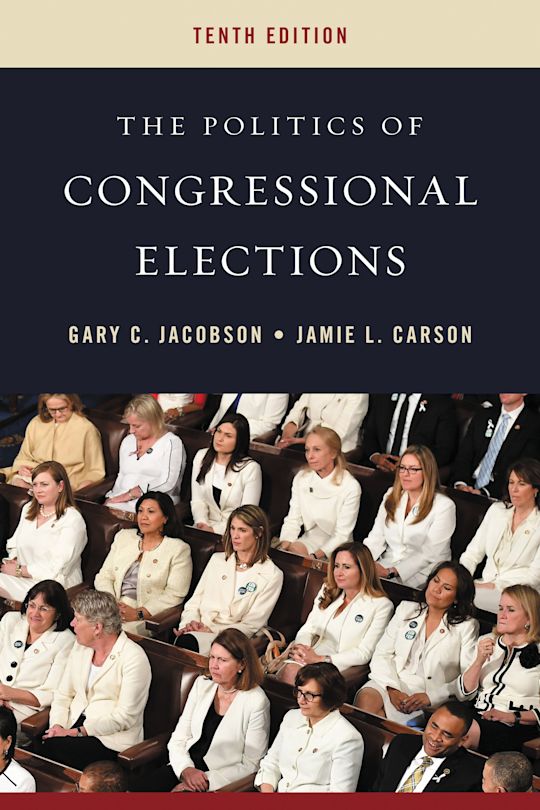

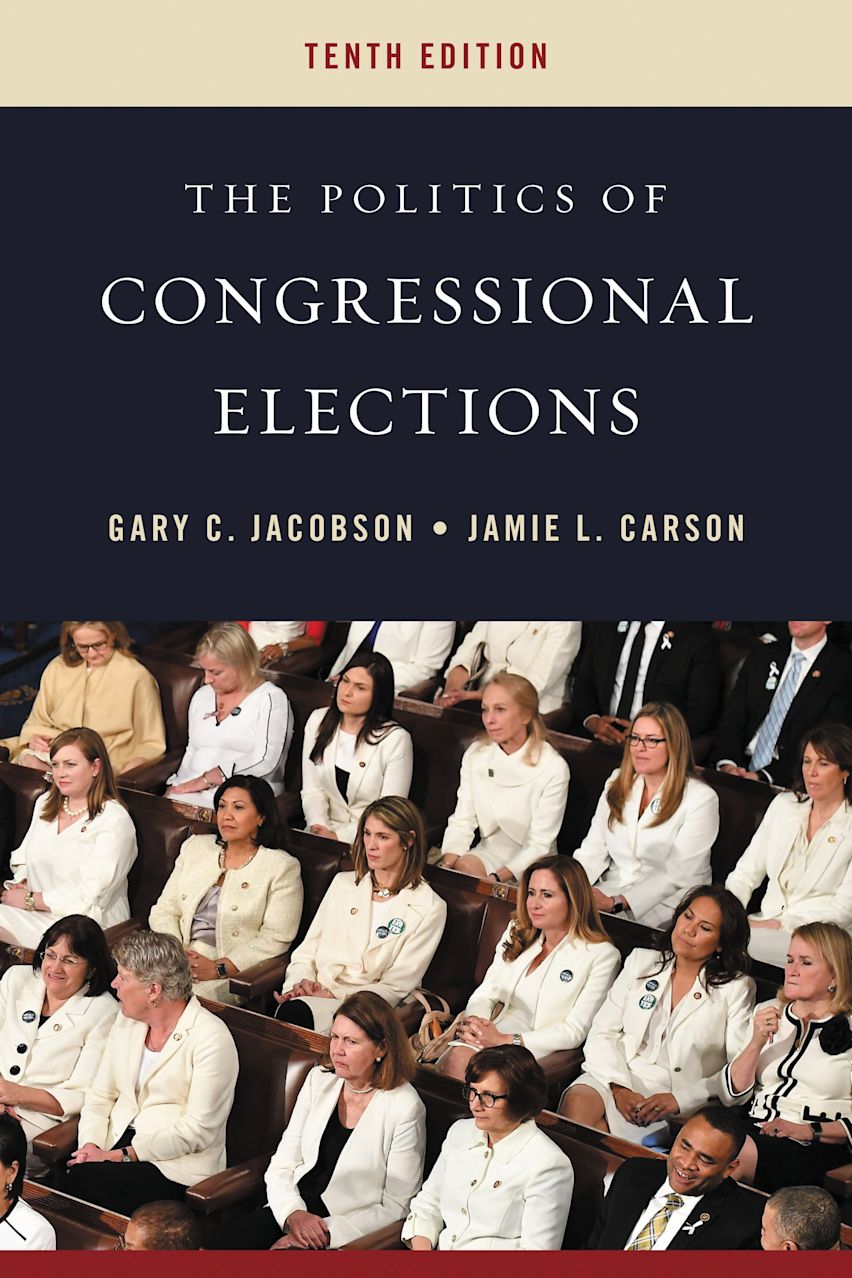
The Politics of Congressional Elections
- Textbook
Please note that this product is not available for purchase from Bloomsbury websites.
Description
Jacobson and Carson provide students with a comprehensive introduction to congressional elections and the electoral process. The tenth edition offers an engaging examination of congressional candidates, campaigns, and elections by incorporating coverage of the most recent elections and the changing roles of voters, incumbents, challengers, and campaign contributions. It examines the first two years of the Trump presidency and its impact on the 2018 midterms with respect to the large number of female candidates running for office and the enormous amounts of money spent by challengers. This edition also highlights the referendum narrative underlying the election in response to behavior and events in the Trump administration. By pairing historical data analysis and original research with fundamental concepts of representation and responsibility, The Politics of Congressional Elections presents students with the tools to evaluate representative government, as well as their own role in the electoral process.
Accessibility Information
Additional accessibility information
- EPUB 3.0
- Conforms with the requirements of EPUB Accessibility Spec v1.1
- WCAG level AA
- WCAG v2.2 compliant
- accessibility@bloomsbury.com
Hazards
The publication contains no hazards
Support for non-visual reading
- No accessibility features offered by the reading system, device or reading software are disabled or otherwise unusable with the product
- Has alternative text descriptions for images
Visual adjustments
Appearance of the text and page layout can be modified according to the capabilities of the reading system (font family and size, spaces, as well as color of background and text)
Navigation
- Page list to go to pages from the print source version
- Elements such as headings, tables, etc for structured navigation
- All or substantially all textual matter is arranged in a single logical reading order
- Content is enhanced with ARIA roles to optimize organization and facilitate navigation
- Purposes of all links are made clear
Rich content
Language tagging provided
Table of Contents
1. Introduction
2. The Context
The Constitutional Framework
Congressional Districts
Partisan Gerrymandering
Redistricting between Censuses
Racial Gerrymandering
Bipartisan Gerrymanders
The Republican Advantage in House Districts
States as Electoral Units
Election Laws
Political Parties
Social and Political Contexts
Conclusion
3. Congressional Candidates
The Incumbency Factor
Measuring the Value of Incumbency
The Vanishing Marginals
Sources of the Incumbency Advantage
The Institutional Characteristics of Congress
Changes in Voting Behavior
Constituency Service
The Variability of the Incumbency Advantage
Discouraging the Opposition
Money in Congressional Elections
The Connection between Money and Success
Why Campaign Money Is More Important to Challengers Than to Incumbents
The Career in the District
Motivating Challengers
4. Congressional Campaigns
Campaign Money
Contributions to Candidates
PACs
PACs and the Pivotal 1994 Election
Party Money
Contributions from Other Members of Congress
Self-Financing by Candidate
Fund-Raising Tactics and Donors
Independent, Voter-Education, and Issue-Advocacy Campaigns
Campaign Organizations
Campaign Strategies
Campaign Media
Personal Campaigning
Campaign Messages
Challengers’ Campaigns
Going Negative
Incumbents’ Campaigns
Candidates for Open Seats
Senate Campaigns
Manipulating Turnout
Conclusion
5. Congressional Voters
Turnout in Congressional Elections
Who Votes?
Partisanship in Congressional Elections
Alternative Interpretations of Party Identification
Partisanship and Voting
Partisanship and Incumbency
Information and Voting
Recall and Recognition of Candidates
Contacting Voters
Changing Evaluations of Incumbents
Issues in Congressional Elections
6. National Politics and Congressional Elections
Political Interpretations of Congressional Elections
Models of Aggregate Congressional Election Results
Presidential Coattails
National Conditions and Strategic Politics
Campaign Themes
House Elections, 1992–2014
1992–2000
2002–2010
2012 and 2014
Senate Elections, 1992–2014
1992–2000
2002–2010
2012 and 2014
Conclusion
7. Elections, Representation, and the Politics of Congress
Representation
Policy Congruence
The Changing Relationship between Constituencies and Roll-Call Votes
Constituents, Interests, and Causes
Representation by Referendum
Descriptive Representation
Policy Consequences
Particularism
Serving the Organized
Responsiveness without Responsibility
The Congressional Parties: Decline and Revival
The Revival of Party Cohesion, 1980–2014
Ideological Polarization in Congress and the Electorate
Polarization in Presidential Support
Party Polarization: The Electoral Connection
Diverging Electoral Constituencies
Chicken or Egg?
The Downside of Strong Party Government
The Public’s Evaluations of Congress
Reforming Congress
Term Limits
2016 and Beyond: Geography and Demography
Bibliography
Index
Product details
| Published | 02 Oct 2019 |
|---|---|
| Format | Ebook (Epub & Mobi) |
| Edition | 10th |
| Pages | 376 |
| ISBN | 9781538123423 |
| Imprint | Rowman & Littlefield |
| Publisher | Bloomsbury Publishing |
Reviews
Related Titles