

This product is usually dispatched within 10-14 days
- Delivery and returns info
-
Free UK delivery on orders £30 or over
Description
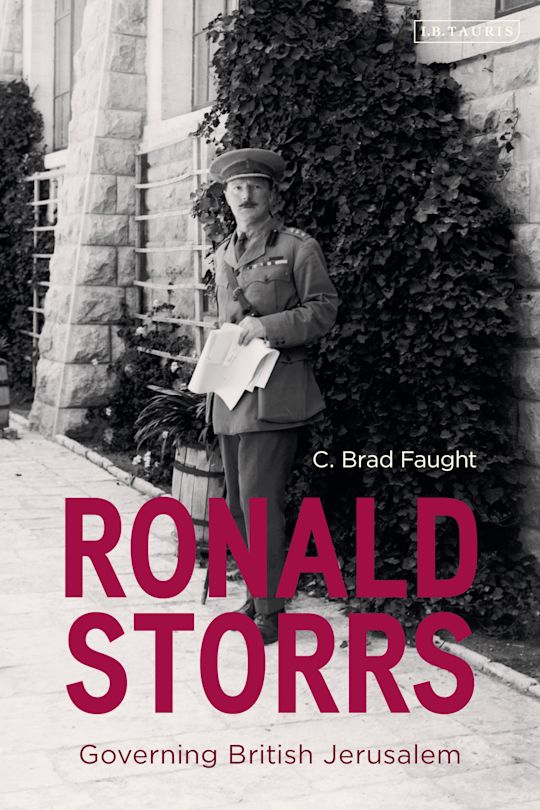
Called by T.E. Lawrence, 'the most brilliant Englishman in the Middle East', Ronald Storrs was a prominent British diplomat and governor who played a leading role in the Anglo-Egyptian government and the Arab Bureau in the years immediately before and during the First World War. In 1917, Storrs became Military Governor of Jerusalem under the British Mandate, in his words, the first such governor 'since Pontius Pilate'.
This book tells the story of Storrs's life in the Middle East by weaving together international affairs, regional geopolitics, statecraft and biography to reassess his influence on British policy during the early years of the twentieth century. During this period, he witnessed the rise of Arab nationalism, the end of the Ottoman Empire and the emergence of Zionism in Palestine. Storrs's governorship of Jerusalem came at a critical juncture in the city's post-war history, and C. Brad Faught analyses his attempts to forge a working peace between Arabs and Jews while seeking also to preserve and protect the Holy City's many sacred spaces. Storrs's record as a colonial governor is examined, and the sharp divisions within Jerusalem's body politic – some of which were created or exacerbated by Britain's own policies – are explored.
Included in the book are many of the leading figures in British and Middle East politics of the time, such as Edmund Allenby, Gertrude Bell, Winston Churchill, King Faisal, Sharif Hussein, David Lloyd George, Chaim Weizmann and Lawrence, By probing the life of an important but understudied British diplomat, the book makes an important contribution to deepening our understanding of the complicated history of the modern Middle East.
Table of Contents
Timeline
Illustrations
Preface and Acknowledgements
Introduction: Britain and the Middle East Across the Nineteenth and Early Twentieth Centuries
Chapter 1 From Cambridge to Cairo
Chapter 2 Oriental Secretary: 1909–1914
Chapter 3 Storrs of Arabia: 1914–1916
Chapter 4 Arabia to Palestine: 1916–1917
Chapter 5 'The first military governor of Jerusalem since Pontius Pilate': 1917–1920
Chapter 6 Colonel Storrs
Chapter 7 Building British Jerusalem: 1920–1921
Chapter 8 At Home in the Holy City: 1921–1926
Conclusion: 'There is no promotion after Jerusalem'
Notes
Bibliography
Index
Product details
| Published | 22 Jan 2026 |
|---|---|
| Format | Hardback |
| Edition | 1st |
| Pages | 240 |
| ISBN | 9780755653409 |
| Imprint | I.B. Tauris |
| Dimensions | 234 x 156 mm |
| Publisher | Bloomsbury Publishing |
Reviews

ONLINE RESOURCES
Bloomsbury Collections
This book is available on Bloomsbury Collections where your library has access.
Related Titles