Texts Without Boundaries: Protocols of Non-Documentary Writing in the Rabbinic Canon
SifrZ to Deuteronomy and Mekhilta Attributed to Rabbi Ishmael
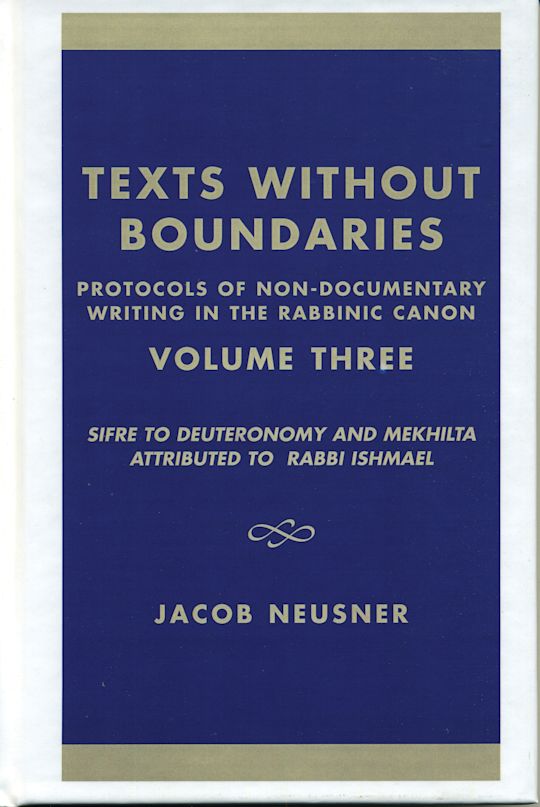

Texts Without Boundaries: Protocols of Non-Documentary Writing in the Rabbinic Canon
SifrZ to Deuteronomy and Mekhilta Attributed to Rabbi Ishmael
Description
The Rabbinic compilations in the canon of Rabbinic Judaism, from the Mishnah through the Bavli, ca. 200-600 C.E., are comprised by two classifications of writing, [1] documentary and [2] non-documentary. Documentary writing conforms to a protocol paramount in, and particular to, a given text, non-documentary writing ignores the distinctive preferences of the compilation in which it appears. The former is defined for each Rabbinic document, respectively, by a unique combination of choices as to form or rhetoric, topic or problem or proposition, and logic of coherent discourse and analysis (terms explained presently). The latter type of writing simply ignores the indicative documentary traits. It thereby crosses the boundaries that separate one text from another, indeed a given canonical compilation from all others. 'Texts without boundaries' refers to writing that ignores the protocols of the document(s) in which it is preserved.
Table of Contents
Chapter 2 Introduction
Chapter 3 The Protocol of Documentary Writing in Sifré to Deuteronomy
Chapter 4 Non-Documentary Writing in Sifré to Deuteronomy. Debarim 1-25
Chapter 5 Non-Documentary Writing in Sifré to Deuteronomy. Vaethanan 26-36
Chapter 6 Non-Documentary Writing in Sifré to Deuteronomy. Eqeb 37-52
Chapter 7 Non-Documentary Writing in Sifré to Deuteronomy. Reeh 53-143
Chapter 8 Non-Documentary Writing in Sifré to Deuteronomy. Shofetim 144-210
Chapter 9 Non-Documentary Writing in Sifré to Deuteronomy. Ki Tese 211-296
Chapter 10 Non-Documentary Writing in Sifré to Deuteronomy. Ki Tabo 297-303
Chapter 11 Non-Documentary Writing in Sifré to Deuteronomy. Nesabim 304-305
Chapter 12 Non-Documentary Writing in Sifré to Deuteronomy. Haazinu 306-314
Chapter 13 Non-Documentary Writing in Sifré to Deuteronomy. Zot Habberakhah 342-357
Chapter 14 Texts Outside of Sifré to Deuteronomy's Bounds
Chapter 15 The Protocol of Documentary Writing in Mekhilta Attributed to R. Ishmael
Chapter 16 Non-Documentary Writing in Mekhilta Attributed to R. Ishmael. Pisha 1-18
Chapter 17 Non-Documentary Writing in Mekhilta Attributed to R. Ishmael. Beshallah 19-25
Chapter 18 Non-Documentary Writing in Mekhilta Attributed to R. Ishmael. Shirata 26-35
Chapter 19 Non-Documentary Writing in Mekhilta Attributed to R. Ishmael. Vayassa 36-42
Chapter 20 Non-Documentary Writing in Mekhilta Attributed to R. Ishmael. Amalek 43-46
Chapter 21 Non-Documentary Writing in Mekhilta Attributed to R. Ishmael. Bahodesh 47-57
Chapter 22 Non-Documentary Writing in Mekhilta Attributed to R. Ishmael. Neziqin 58-75
Chapter 23 Non-Documentary Writing in Mekhilta Attributed to R. Ishmael. Kaspa 76-80
Chapter 24 Non-Documentary Writing in Mekhilta Attributed to R. Ishmael. Shabbata 81-2
Chapter 25 Texts Outside of Mekhilta Attributed to R. Ishmael's Bounds
Product details
| Published | 30 Jul 2002 |
|---|---|
| Format | Ebook (Epub & Mobi) |
| Edition | 3rd |
| Extent | 290 |
| ISBN | 9781461689133 |
| Imprint | University Press of America |
| Series | Studies in Judaism |
| Publisher | Bloomsbury Publishing |
Related Titles