
Please note that this product is not available for purchase from Bloomsbury websites.
Description
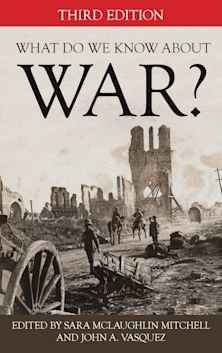
What Do We Know about War? reviews the research on causes of war and the conditions of peace over the past forty-five years. Leading scholars explore the critical roles of territorial disputes, alliances, arms races, rivalry, and nuclear weapons in bringing about war as well as the factors promoting peace, including democracy, norms, stable borders, and capitalist economies. Considering what has been learned about the causes of war and the conditions of peace in the ten years since the publication of the first edition, this invaluable text offers an accessible and up-to-date overview of current knowledge and an agenda for future research.
Contributions by: Brett V. Benson, Paul F. Diehl, Colin Flint, Daniel S. Geller, Douglas M. Gibler, Gary Goertz, Paul R. Hensel, Choong-Nam Kang, Jack S. Levy, Zeev Maoz, Sara McLaughlin Mitchell, Michael Mousseau, Karen Rasler, Susan G. Sample, William R. Thompson, Brandon Valeriano, John A. Vasquez, and Peter Wallensteen.
Table of Contents
John A. Vasquez
Part I: Factors that Bring about War
Chapter 1: Territory: Geography, Contentious Issues, and World Politics
Paul R. Hensel
Chapter 2: Alliances: Path to Peace or Path to War?
Choong-Nam Kang
Chapter 3: Alliances: ATOP Data and Deterrence
Brett V. Benson
Chapter 4: Becoming Rivals: The Process of Rivalry Development
Brandon Valeriano
Chapter 5: The Rivalry Process: How Rivalries Are Sustained and Terminated
Paul F. Diehl and Gary Goertz
Chapter 6: Arms Races: A Cause or a Symptom?
Susan G. Sample
Chapter 7: Nuclear Weapons and War
Daniel S. Geller
Part II: Factors that Promote Peace
Chapter 8: Norms and the Democratic Peace
Sara McLaughlin Mitchell
Chapter 9: A Market-Capitalist or a Democratic Peace?
Michael Mousseau
Chapter 10: The Implications of a Territorial Peace
Douglas M. Gibler
Part III: Reflections and Conclusions on the Scientific Study of Peace and War
Chapter 11: War-Making and State-Making: How and Where Does It Fit into a Bigger Picture?
Karen Rasler and William R. Thompson
Chapter 12: Future Directions in the Scientific Study of Peace and War
Peter Wallensteen
Chapter 13: Normal Science and Open Questions: Reflections on the Study of Peace and War, 2001–2011
Zeev Maoz
Chapter 14: The "Paths to War" Concept
Jack S. Levy
Chapter 15: Peace Science as Normal Science: What Role for Geography in the Coming Revolution?
Colin Flint
Chapter 16: What Do We Know about War?
John A. Vasquez
References
Product details
| Published | 16 Mar 2012 |
|---|---|
| Format | Ebook (Epub & Mobi) |
| Edition | 2nd |
| Extent | 410 |
| ISBN | 9781442212657 |
| Imprint | Rowman & Littlefield Publishers |
| Publisher | Bloomsbury Publishing |
Reviews
Related Titles