- Home
- ACADEMIC
- Archaeology
- Archaeology - Other
- Archaeological Thinking
Archaeological Thinking
How to Make Sense of the Past
- Textbook
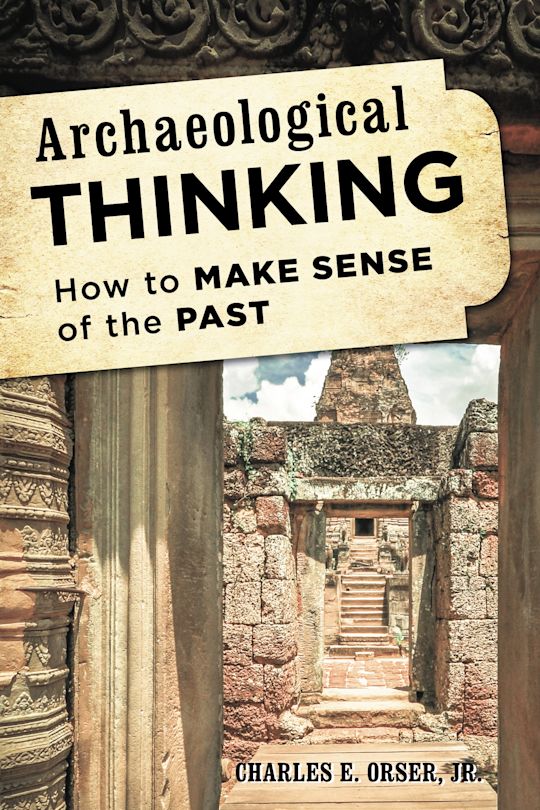
Archaeological Thinking
How to Make Sense of the Past
- Textbook

Please note that this product is not available for purchase from Bloomsbury websites.
Buy from Bloomsbury eTextBooks
You are now leaving the Bloomsbury Publishing website. Your eBook purchase will be with our partner https://www.vitalsource.com.
Your credit card statement will show this purchase originating from VitalSource Technologies. They will also provide any technical assistance you might require.
You must sign in to add this item to your wishlist. Please sign in or create an account
Description
How do archaeologists think? How do they use the scattered and often-fragmentary remains from the past—both historical and excavated—to create meaningful, sensible interpretations of human history? In Archaeological Thinking, Charles E. Orser Jr., provides a commonsense guide to applying critical thinking skills to archaeological questions and evidence.
Rather than critiquing and debunking specific cases of pseudo-archaeology or concentrating on archaeological theory, Orser considers the basics of scientific thinking, the use of logic and analogy, the meaning and context of facts, and the evaluation of source materials. He explains, concisely and accessibly, how archaeologists use these principles to create pictures of the past and teaches students to develop the skills needed to make equally reasoned interpretations.
Table of Contents
1. What’s This All About, Anyway? Thinking in Archaeology
A Question of Belief?
Science versus History
Thinking to Some Purpose
The Process of Clear Thinking
A Brief History of Archaeo-Thinking
Postmodern Thinking
Continue Reading
2. It All Seems So Sciencey: Archaeology, Science, and History
How Do Archaeologists Use Science and History to Think?
SEARCHing
Plausibility
The Exeter Mystery
The Ongoing Tussle between Evidence and Perspective
The Changing Nature of Coarse, Low-Fired Earthenware
3. Those Pesky Facts: Understanding Historical Facts
Can Facts Be Selected?
Is Fact Selection Dishonest?
Glass Beads and Glass Buttons
We Really Do Select Facts?
Continue Reading
4. If p . . . Then What? Archaeological Thinking and Logic
Our Love of Logic
Deducing
Not Deduction, the Other One . . .
I’ve Been Abducted
Continue Reading
5. Is That Chair Really a Chair? Analogy and Archaeological Thinking
Archaeologists and Analogy
The Direct Historical Approach
Ethnographic Analogy
Evaluating Analogy Strength
What Is the Purpose of Analogy in Archaeology?
Continue Reading
6. Source-Thinking: The Relationship between Archaeological and Textual Evidence
What Is History?
Archaeology and History
“Historical” Sources
Reading the Declaration of Independence
The Search for Saint Brendan the Navigator
Continue Reading
7. Artifact-Thinking: Archaeological Thought and Excavated Things
Ceramics as Historical Documents
Ceramics as Commodities
Ceramics as Ideas
Continue Reading
8. Thinking to Some Purpose: Archaeological Research and Critical Thinking
The Danger of Faulty Archaeo-Thinking
Final Thoughts
Continue Reading
Index
About the Author
Product details
| Published | Oct 30 2014 |
|---|---|
| Format | Ebook (Epub & Mobi) |
| Edition | 1st |
| Extent | 190 |
| ISBN | 9781442226999 |
| Imprint | Rowman & Littlefield Publishers |
| Publisher | Bloomsbury Publishing |
About the contributors
Reviews
-
Anthropologist Orser wrote his book for students and educated readers. He describes how to think about the past like an archaeologist and is eminently successful in that effort. In the first chapter, he discusses critical thinking versus belief, the relation between science and history, and a brief history of archaeological thinking. Following chapters cover such topics as systematic approaches to critical thinking, the nature of facts and their selection, the use of logic both deductive and inductive, the various uses of analogy, the use of sources as evidence, and the use of artifacts as evidence. Throughout, Orser provides helpful examples, mostly drawn from the realm of pseudo history—the Great Pyramid as a power plant, the myth of the Mound Builders, and St. Brendan’s discovery of America, among others. The final chapter discusses the dangers of faulty archaeological thinking through the examples of the racist interpretations placed on the ruins of Great Zimbabwe and the work of Nazi archaeologists supporting Aryans as innately superior. At times, Orser seems to privilege scientific thinking over historical thinking, but overall, this book should be a model for similar titles in other disciplines and of interest to anyone teaching critical thinking. Summing Up: Highly recommended. All public and undergraduate collections.
Choice Reviews
-
The methods discussed in the book. . . .in addition to the use of critical thinking and logic, can aid anyone in determining whether a theory/hypothesis is plausible. By discussing these ideas in one source, Orser has provided a valuable resource to anyone who finds themselves questioning. The easy to read format, vivid examples, and humor, make Archaeological Thinking: How to Make Sense of the Past well worth the read.
Historical Archaeology
-
Interpretations of the past often function as social charter myths condoning terrible injustices. These are serious matters that should be addressed in a textbook that teaches the methodology of archaeological thinking. Orser’s expositions of logic and its use in archaeology are well done and start the student in this direction.
Journal of Eastern Mediterranean Archaeology and Heritage Studies
-
A clearly written and genuinely fun little book that will be required reading in my class on pseudoscience and the past! In a terrific counterpoint to speculative conjectures of pseudo-archaeology, Orser situates archaeology between the sciences and history and carefully explains why the demand for solid evidence makes archaeology a very conservative field when it comes to claims about the past. Rather than debunking specific outrageous claims, he focuses on the critical thinking skills archaeologists use. Readers will learn how to apply those skills, and in turn, to recognize evidentiary gaps and logical flaws of any claim about the past.
Larry J. Zimmerman, Indiana University-Purdue University, Indianapolis
-
Critical thinking is at the core of archaeology, but it can be quite a task to convey these skills to students. Orser’s Archaeological Thinking covers the basics with well-supported arguments and by using a tone that is perfect for introductory students and lay readers alike.
Travis W. Stanton, University of California, Riverside
-
An essential primer for introductory and veteran students alike. In this lucid little book, Orser provides a clear and concise discussion of how archaeologists create knowledge about the human past. He contrasts ‘archaeo-thinking’ with pseudo-archaeology to explore issues of fact selection, logic, analogy, material culture, historical documents, and critical thinking.
LouAnn Wurst, Michigan Technological University
ONLINE RESOURCES
Bloomsbury Collections
This book is available on Bloomsbury Collections where your library has access.