- Home
- ACADEMIC
- Literary Studies
- Modernism
- The Complicit Text
The Complicit Text
Failures of Witnessing in Postwar Fiction
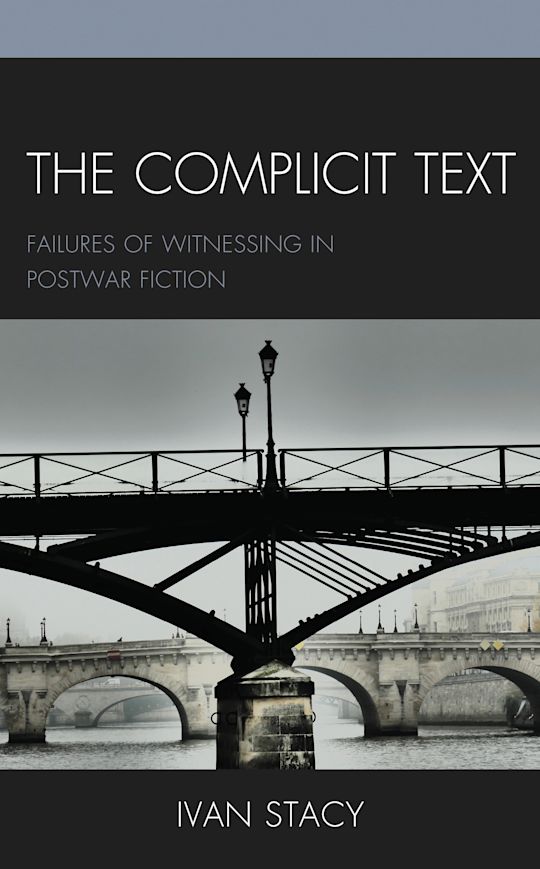
The Complicit Text
Failures of Witnessing in Postwar Fiction

This product is usually dispatched within 1 week
- Delivery and returns info
-
Free US delivery on orders $35 or over
You must sign in to add this item to your wishlist. Please sign in or create an account
Description
The Complicit Text: Failures of Witnessing in Postwar Fiction identifies the causes of complicity in the face of unfolding atrocities by examining the works of Albert Camus, Milan Kunera, Kazuo Ishiguro, W. G. Sebald, Thomas Pynchon, and Margaret Atwood. Ivan Stacy argues that complicity often stems from narrative failures to bear witness to wrongdoing. However, literary fiction, he contends, can at once embody and examine forms of complicity on three different levels: as a theme within literary texts, as a narrative form, and also as it implicates readers themselves through empathetic engagement with the text. Furthermore, Stacy questions what forms of non-complicit action are possible and explores the potential for productive forms of compromise. Stacy discusses both individual dilemmas of complicity in the shadow of World War II and collective complicity in the context of contemporary concerns, such as the hegemony of neoliberalism and the climate emergency.
Table of Contents
Introduction
Chapter 1. Complicit Silences: Albert Camus
Chapter 2. The Trap of Totalitarianism: Milan Kundera
Chapter 3. Consolation and Complicity: Kazuo Ishiguro
Chapter 4. Traces of Complicity: W. G. Sebald
Chapter 5. Paranoid Conspiracy: Thomas Pynchon
Chapter 6. Compromised Narratives: Margaret Atwood’s Dystopias
Conclusion
Bibliography
Product details
| Published | Dec 10 2020 |
|---|---|
| Format | Hardback |
| Edition | 1st |
| Extent | 230 |
| ISBN | 9781498598705 |
| Imprint | Lexington Books |
| Dimensions | 10 x 6 inches |
| Series | Reading Trauma and Memory |
| Publisher | Bloomsbury Publishing |
About the contributors
Reviews
-
In this ground-breaking study, Ivan Stacy reassesses the significance of complicity, as a kind of responsibility beyond that of a bystander, yet not quite that of a perpetrator, within a cultural context. He does so by means of careful and convincing analyses of novels that make visible failures to confront or even to acknowledge wrong-doing, in contexts ranging from the Holocaust and the Cold War to ecological emergency and the injustices of neoliberalism. This study is as timely as it is innovative, on a topic that concerns us all.
Sue Vice, Professor of English Literature, The University of Sheffield
-
The Complicit Text explores a stunning central premise: the complicity of ordinary individuals in systems of wrongdoing, if not oppression, may be a more general feature of the human experience than many people like to imagine. Ivan Stacy’s incisive and highly accessible case studies identify notable works of literature as conceptual resources for contemplating the limits or failures of witnessing, narrative, and testimony in the face of one’s potentially undeniable complicity. The result is a vital scholarly study that not only draws new significance from important works of literature, but does so in ways that address the timely question of how we should narrate our degrees of complicity in present-day oppression, violence, and injustice.
Bradford Vivian, Pennsylvania State University
-
In recent years, complicity studies have expanded rapidly. Focussing on failures of witnessing, wilful blindness and culpable ignorance, Ivan Stacy’s The Complicit Text makes a significant contribution to this burgeoning field. Lucidly argued and accessibly written, the volume expands our understanding of and our ability to recognise complicity mainly but not exclusively as it relates to cultural production. The theoretical framework provides an intelligent and fresh interpretive angle to key works by Albert Camus, Milan Kundera, Kazuo Ishiguro, W.G. Sebald and Margaret Atwood, while implicitly inviting us to probe our own relation to collective moral wrongdoing.
Cornelia Wächter, Assistant Professor of British Cultural Studies, Ruhr University Bochum, Germany
ONLINE RESOURCES
Bloomsbury Collections
This book is available on Bloomsbury Collections where your library has access.