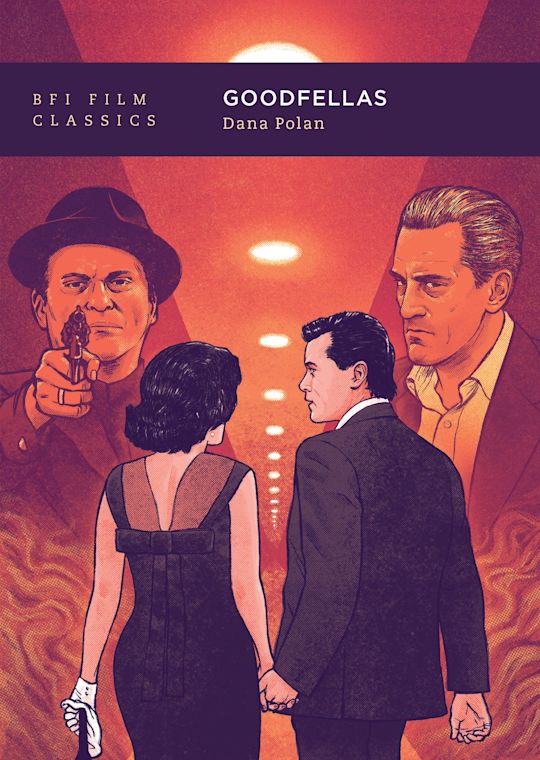

Goodfellas
Buying pre-order items
Ebooks and Audiobook
You will receive an email with a download link for the ebook or audiobook on the publication date.
Payment
You will not be charged for pre-ordered books until they are available to be shipped. Pre-ordered ebooks will not be charged for until they are available for download.
Amending or cancelling your order
For orders that have not been shipped you can usually make changes to pre-orders up to 72 hours before the publishing date.
Payment for this pre-order will be taken when the item becomes available
- Delivery and returns info
-
Free US delivery on orders $35 or over
Description
Martin Scorsese's 1990 movie Goodfellas, starring Robert De Niro, Ray Liotta, Joe Pesci, Lorraine Bracco and Paul Sorvino, narrates the rise and fall of Mafia associate Henry Hill and his friends and family from 1955 to 1980. The film's focus is on the half-Irish Henry Hill (Liotta) and his Jewish spouse Karen (Bracco), who envy the gangster lifestyle but can never fully be part of the Mafia's inner circle because of their ethnic identities. Dana Polan's compelling study chronicle the production history of the film, starting with Nick Pileggi's source book, Wiseguy (1985) and its transformation into a script by Pileggi and Scorsese. He moves on to to consider thematic and formal aspects of the movie: the many moments (aural as well as visual) that make filmic form palpable and celebrate cinematicness; Goodfellas' ethnographic concern with communities whose members build up special worlds for themselves; and connected to that, the complicated relation between artists and other kinds of world-builders (such as the Mafia men Scorsese depicts through his own art of cinema); the complicated
interweave of dynamic form and morally dubious content; a narrative that has the ambition of historical sweep combined with a complicated, frequently nonchronological time-frame; the contrast between everyday victims and the special community (of criminals); the role of outsiders who want in (like Henry and
eventually Karen – who at first wants to stay out but is seduced eventually into the lifestyle), and the function of voice-over narration. Polan concludes with a consideration of the film's reception and its lasting impact on later popular culture such as the TV series The Sopranos.
Table of Contents
Goodfellas
Notes
Credits
Product details
| Published | Nov 12 2026 |
|---|---|
| Format | Paperback |
| Edition | 1st |
| Pages | 104 |
| ISBN | 9781805750505 |
| Imprint | British Film Institute |
| Dimensions | 7 x 5 inches |
| Series | BFI Film Classics |
| Publisher | Bloomsbury Publishing |
Related Titles