- Home
- ACADEMIC
- Politics & International Relations
- Russian, Soviet and Post Soviet Politics
- Russia's Foreign Policy
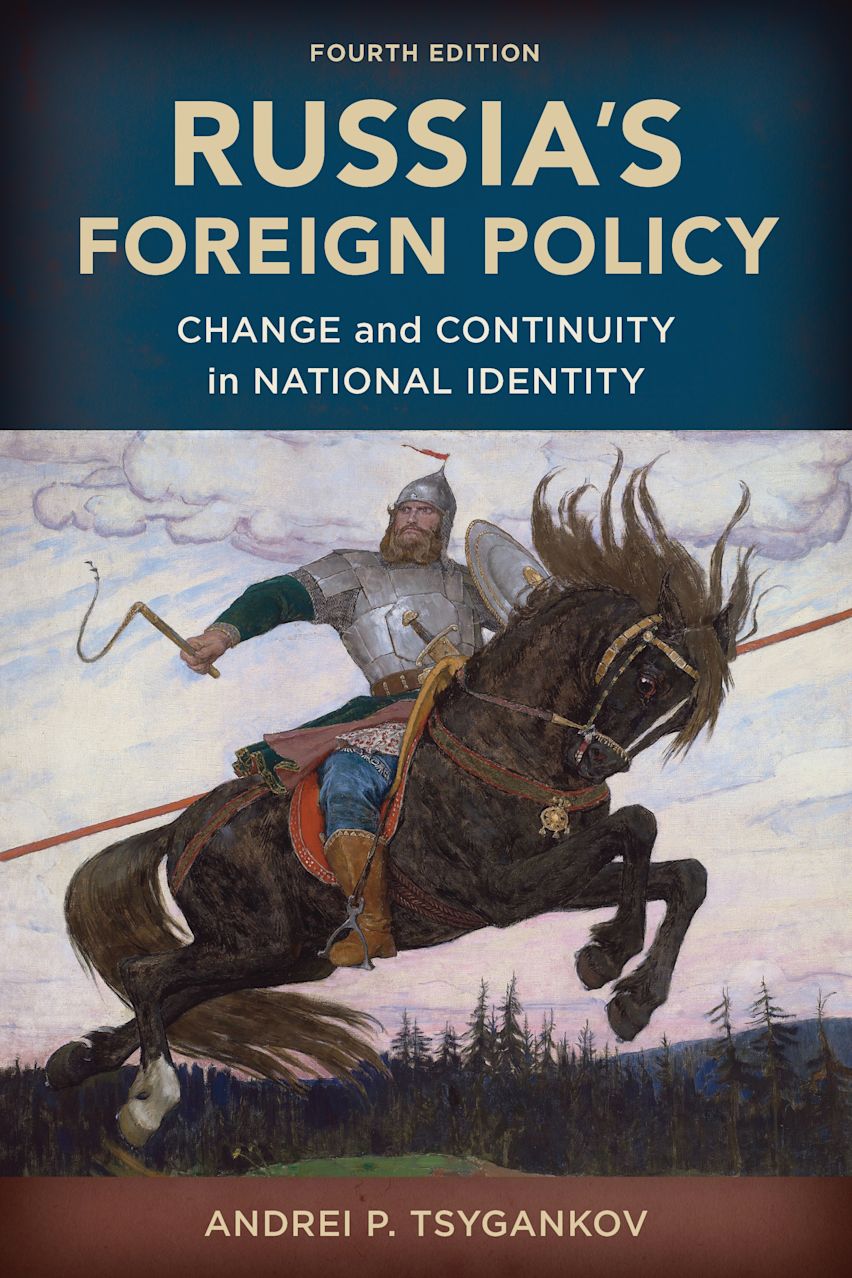
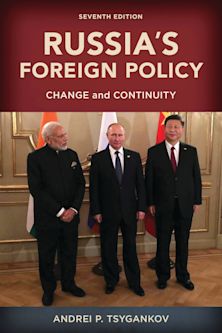
Russia's Foreign Policy
Change and Continuity in National Identity
- Textbook
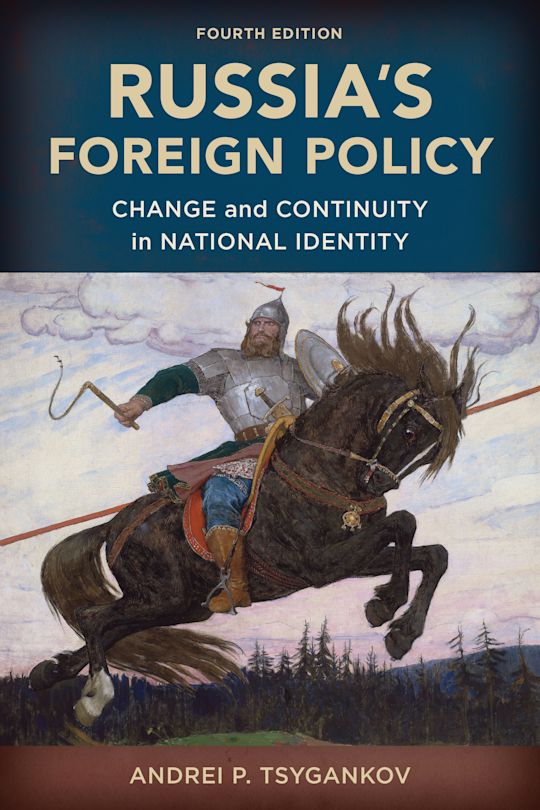
Russia's Foreign Policy
Change and Continuity in National Identity
- Textbook

Please note that this product is not available for purchase from Bloomsbury websites.
Buy from Bloomsbury eTextBooks
You are now leaving the Bloomsbury Publishing website. Your eBook purchase will be with our partner https://www.vitalsource.com.
Your credit card statement will show this purchase originating from VitalSource Technologies. They will also provide any technical assistance you might require.
You must sign in to add this item to your wishlist. Please sign in or create an account
Description
Now fully updated and revised, this clear and comprehensive text explores contemporary Soviet/Russian international relations, comparing foreign policy formation under Gorbachev, Yeltsin, Medvedev, and Putin. Challenging conventional views of Moscow’s foreign policy, Andrei Tsygankov shows that definitions of national interest depend on visions of national identity and are rooted both in history and domestic politics. Yet the author also highlights the role of the external environment in affecting the balance of power among competing domestic groups.
Drawing on both Russian and Western sources, Tsygankov traces how Moscow’s policies have shifted under different leaders’ visions of Russia’s national interests. He gives an overview of the ideas and pressures that motivated Russian foreign policy in six different periods: the Gorbachev era of the late 1980s, the liberal “Westernizers” era under Kozyrev in the early 1990s, the relatively hardline statist policy under Primakov, the more pragmatic course of limited cooperation under Putin and then Medvedev, and the assertive policy Putin has implemented since his return to power. Evaluating the successes and failures of Russian foreign policies, Tsygankov explains its many turns as Russia’s identity and interaction with the West have evolved. The book concludes with reflections on the emergence of the post-Western world and the challenges it presents to Russia’s enduring quest for great power status along with its desire for a special relationship with Western nations.
Table of Contents
List of Tables
Chronology of Key Foreign Policy Events, 1985–2015
Preface
Chapter 1: Understanding Change and Continuity in Russia’s Foreign Policy
Chapter 2: The Cold War Crisis and the Soviet New Thinking
Chapter 3: Post–Cold War Euphoria and Russia’s Liberal Westernism
Chapter 4: New Security Challenges and Great Power Balancing
Chapter 5: The World after September 11 and Pragmatic Cooperation
Chapter 6: U.S. Regime Change Strategy and Great Power Assertiveness
Chapter 7: Global Instability and Russia’s Vision of Modernization
Chapter 8: The West, the Non-West, and Russia’s “Civilizational” Turn
Chapter 9: Conclusions and Lessons
Essential Reading
Topics for Discussion or Simulation
Index
About the Author
Product details
| Published | Jan 15 2016 |
|---|---|
| Format | Ebook (Epub & Mobi) |
| Edition | 4th |
| Extent | 336 |
| ISBN | 9781442254039 |
| Imprint | Rowman & Littlefield Publishers |
| Illustrations | 40 Tables |
| Publisher | Bloomsbury Publishing |
About the contributors
Reviews
-
Tsygankov is one of the world’s leading analysts of the complexities of Russian foreign policy, and in this volume he makes available, in a concise and easily accessible format, his knowledge distilled from years of study of the subject. He steers a sophisticated path between pro-Western liberal views and various anti-Western Russian nationalist mythologies to provide a convincing and coherent study of the relationship between national identity and foreign policy. A must-read for all serious students of Russian foreign policy and of the country’s place in the world.
Richard Sakwa, Professor of Russian and European Politics, University of Kent
-
This book is based on a profound understanding of how Russian policymakers view the world and the impact of those views on their foreign-policy behavior. It is a must read for scholars, students, and the educated citizenry.
George Breslauer, University of California, Berkeley
-
A very coherent analysis. . . . There are few studies that so convincingly demonstrate how Russia's foreign policy has been consistently determined in large part by Moscow's relationship and attitudes towards the 'West.' . . . An excellent book.
Seer
-
[A] well-documented summary of the main directions of Russia's foreign policy from the Gorbachev period through the fifth year of Putin's presidency.
The Russian Review
-
Tsygankov (San Francisco State Univ.) provides an accessible, invaluable contribution to the teaching and analysis of Russia's post–Cold War foreign policy. This relatively short book aims to provide both a historic overview and a theoretic framework for analyzing the formation and conceptualization of Russia's national interest, with particular emphasis on Russia's historic and evolving relationship with the West. The book contains a chronology of Russian foreign policy from 1985 to the present, and relies on many original Russian-language sources. The work is divided into eight chapters, with a historic overview, a basic introduction to international relations theory and its implications for understanding Russian foreign policy, as well as chapters on Gorbachev's new thinking, Russia as great-power balancer, Russia as great-power pragmatist, and Russia as an assertive great power. It concludes by analyzing prospects for change and continuity in Russian foreign policy. Recommended.
Choice Reviews
-
Simply the best undergraduate textbook on contemporary Russian foreign policy available today.
Theodore Hopf, National University of Singapore